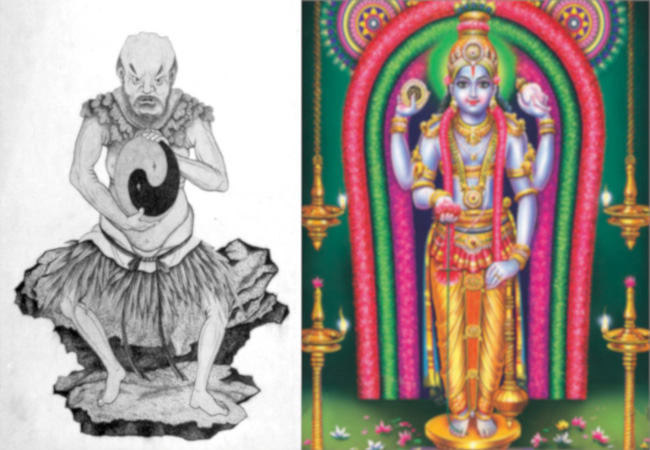
The creation myths from China and India show strong similarities, including the cosmic egg, the primordial beings, and the principle of opposites and chaos. Firstly, the cosmic egg is present in both. In the Indian Shatapatha Brahmana, the creator Prajapati broke out of a cosmic egg. In another Indian text, the Chandoyga Upanishad, a cosmic egg broke in two parts containing all elements of creation, including Brahma and the sun (Lemming 25). In the Chinese myth, Pangu breaks out of the cosmic egg containing yin and yang (Lemming 27). The two primal beings Purusha and Pangu both died to create the earth, with their bodies becoming part of it. Purusha’s bottom quarter became the world, and out of his sacrifice emerged the plants and animals, the rituals, and the sacred words of the Vedas. While parts of his body became the castes of India, his mind also became the moon, his eye the sun, and his breath the wind. The sky emerged from his head, and the earth from his feet (Lemming 25). Just like Purusha, Pangu’s skull becomes the top of the sky, and his breath becomes wind, although the similarities end there, with his voice becoming thunder, his legs and arms the four directions, his flesh becoming the soil, and his blood the rivers. Meanwhile, the fleas on his hair became humans (Lemming 27). The fact that the primal beings become nature itself likely shows how both the Chinese and Indian cultures saw nature as being composed of different parts working together as one. This also shows how highly they viewed nature.
Another similarity between the two stories is the principle of opposites and chaos. In the Chinese myth, this is represented by yin and yang, with everything being made of those principles: female-male, cold-heat, passive-active and dark-light. Phan Ku separated ying and yang, including the earth and sky (Lemming 27). The Rig Veda sings of the necessity of opposites: Being requires Non-Being. Atman-Purusha breaks into two parts, and tries to marry himself, but his female self transforms into different creatures such as a cow and mare, with Purusha in turn transforming himself into a bull, stallion and other creatures (Lemming 26). Just like the yang principle gives and the yin principle receives, Atman-Purusha gave sexual intercourse to his female half. Thus, Pangu and Atman-Purusha are both composed of the coming together of opposites.
The similarities in the two myths are not surprising, as Chinese and Indian cultures were both very spiritual and had some similar ideas and concepts. They also had plenty of cultural exchange, with Buddhism from India later influencing Chinese and by extension the wider East Asian culture. Both the Chinese and Indians also created martial arts. So, it is not difficult for me to see why there are these similarities in the two myths.
Works Cited
Lemming, David A. The World of Myth: An Anthology. New York: Oxford University Press, 2019.
 diegodelaparra
Leave a comment