
The Crusades in the Middle East are very well known in our culture, as they have been featured in video games such as Assassin’s Creed and movies such as the Kingdom of Heaven. However, the Reconquista in Spain is less known, although it took place for far longer, exactly 781 years from 711 to 1492 AD, easily the longest conflict in human history. Meanwhile, the Middle Eastern crusades only occurred between 1096, the beginning of the First Crusade, and 1291 AD, the year that the city of Acre, the last Western Christian stronghold in the Middle East, fell to the Saracens. Unlike the Middle Eastern Crusades, the Reconquista ended with victory, with all of Spain and Portugal being liberated from the Muslim Moors. This will be a short overview of the Reconquista, which is divided into 3 distinct periods.
1st Period: Moorish Supremacy (711-1031)
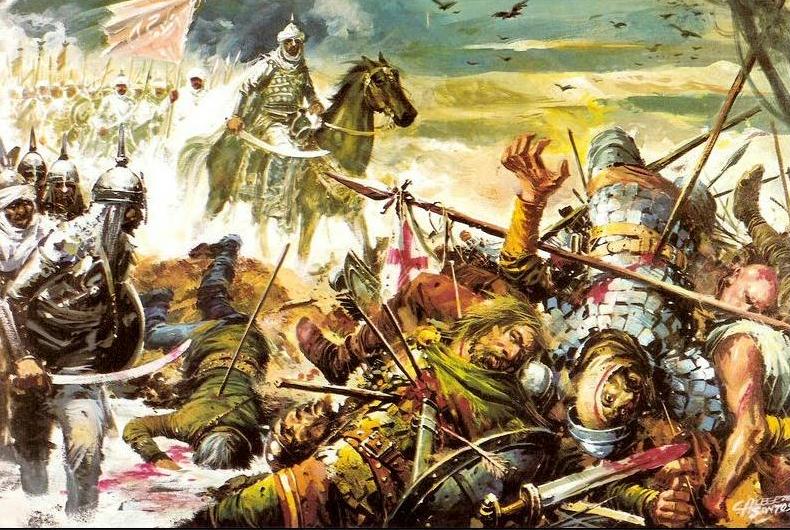
In 711, the Umayyad Caliphate invaded the Iberian Peninsula, then under Visigothic rule. That same year, an army of Arabs and Berbers led by Tariq ibn Ziyad defeated the Visigoths under King Roderic at the Battle of Guadalete. The Umayyads then swept through the Iberian Peninsula and almost completely conquered it. However, Christians led by the nobleman Pelayo of Asturias (685-737) withdrew to the remote mountainous northwest, forming the small Kingdom of Asturias. The Umayyads tried to take this last Christian refuge, but were defeated by Pelayo’s armies in the Battle of Covadonga in 722. Although the Kingdom of Asturias was saved, it remained small, isolated, and unable to mount much of a challenge to the dominant Moors. But many more small Christian kingdoms, including Navarre in the northeast and Aragon in the east, began to form.
Trouble would ensue for the Umayyads with the Abbasid Revolution, lasting from June 9, 747 to July 750, and ending with the overthrow of the Umayyads by the Abbasids, who established a new caliphate in Damascus. Meanwhile, Moorish Spain, named Al-Andalus, stayed loyal to the Umayyads and formed the Caliphate of Cordoba in 929 against the Abbasids. Under the Cordoban caliphs, Al-Andalus became a beacon of learning with a flowering of arts, philosophy, astronomy, mathematics, medicine and science.
For about 3 centuries, every summer, Umayyad armies marched north to raid the Christian kingdoms, taking slaves and treasures. This peaked in 997 when the Umayyad commander Al-Mansur ravaged Galicia and burned down the shrine at Santiago de Compostela, sending the Church bells back to Cordoba to serve as lanterns in the Great Mosque. The difficult circumstances of the early years of the Reconquista sharpened the Asturians into a fierce and aggressive people.
2nd Period: Struggle for Spain (1031-1212)

In 1031, the Caliphate of Cordoba crumbled into many quarreling city-states called taifas. At the same time, the Asturians had grown into the Kingdom of Leon-Castile, which began to turn the tables against the Moors. King Fernando I of Leon (born c. 1015, reigned 1037-1065) took over the area that would become Northern Portugal, while his son Alfonso VI conquered Toledo in 1085. The Kings of Leon now had the ability to raid deep into Al-Andalus, and it appeared the Christians would take over all of Iberia.
But a new threat arose from North Africa, the Almoravid Dynasty (1040-1147), which exerted it’s influence over the taifas. King Alfonso VI suffered a crushing defeat to the Almoravids at the Battle of Sagrajas in 1086. At this point, the Christians and Moors were equally matched in Spain. The Christians now controlled more land and would push their borders further to the south. King Alfonso the Battler of Aragon took Zaragoza from the Moors in 1118. The Almoravid’s strength had failed, but once again, a new enemy rose in North Africa, the Almohads (1121-1269), radical and austere Berber warriors who controlled Moorish Spain in the 12th century. In 1195, the Almohads vanquished King Alfonso VIII, the King of Castile, at the Battle of Alarcos. The Spanish Christian kingdoms were in peril once again.
3rd Period: Christian Supremacy (1212-1492)

Alfonso VIII avenged his loss when he, along with Sancho VII of Navarre and Pedro II of Aragon, vanquished the Almohads at the Battle of Las Navas de Tolosa in 1212, changing the course of the Reconquista. the Almohads lost their dominance of Spain. In the later years of the 13th centuries, the Christian kings conquered most of the remainder of Al-Andalus. James I of Aragon conquered Valencia in 1238, while Fernando III of Leon-Castle (born 1199, reigned 1217-1252) took Cordoba in 1236 and Sevilla in 1248. Fernando III turned Cordoba’s Great Mosque into a cathedral and returned the bells stolen by Al-Mansur centuries earlier to Santiago de Compostela.
The only territory left for the Moors was Granada, on Spain’s southeastern tip. The emirs of Granada usually payed tribute to the Christian kings of Spain. However, different problems prevented the Spanish from taking Granada for more than 200 years, including the civil wars in Portugal, Castile and Aragon, and the Black Death (1347-1351) which devastated the population. Finally, in the year 1469, Fernando II of Aragon and Isabella I of Castile were married. Together they launched the Granada War (1481-1492), conquering the last Moorish stronghold in the peninsula and turning Spain completely Christian for the first time in nearly 800 years.
 diegodelaparra
Leave a comment