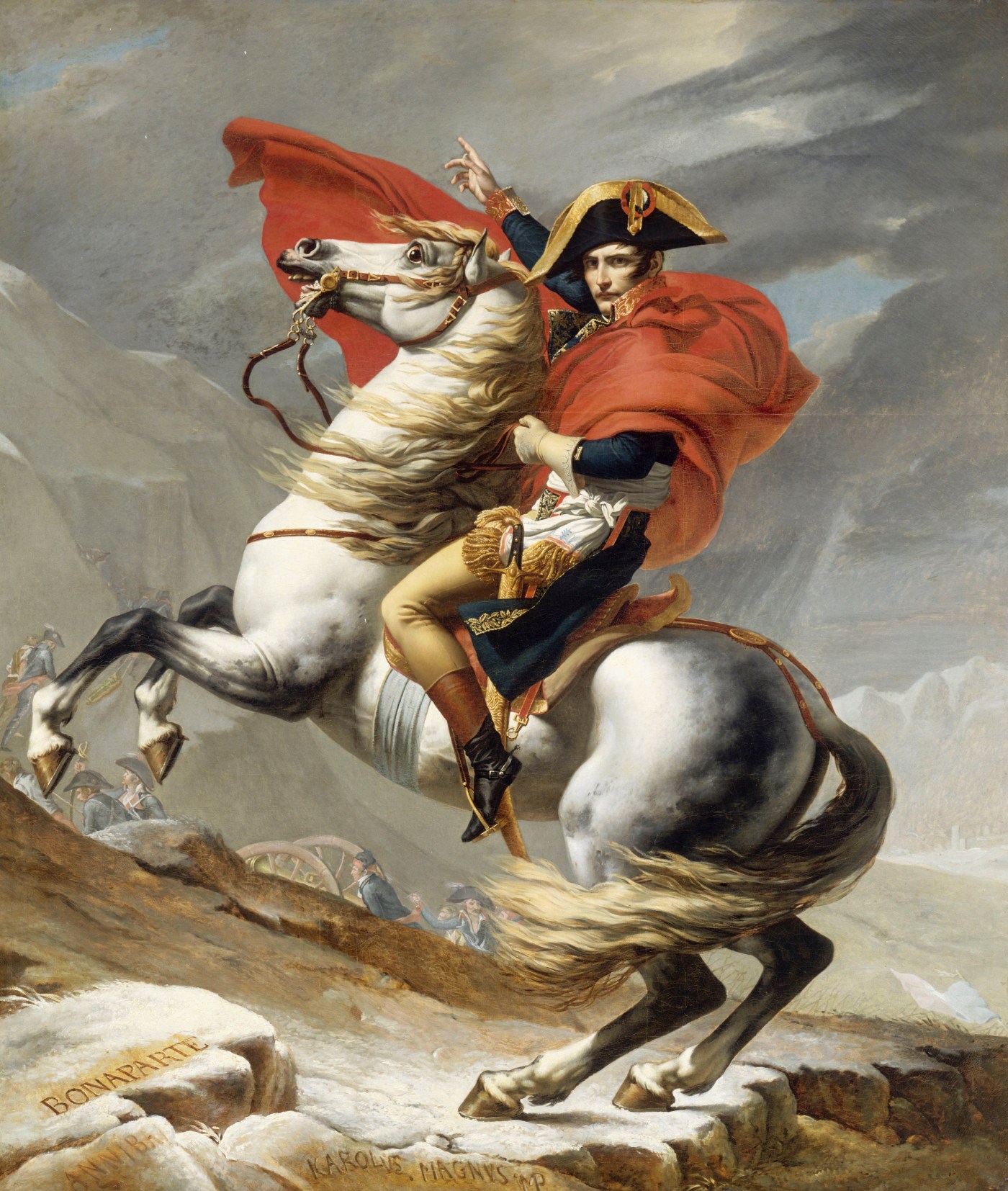
Napoleon Bonaparte was a French General and statesman who was active during the late 18th and early 19th centuries. He is widely considered one of the greatest leaders and military geniuses of all time. He rose through the ranks of the French military quickly, becoming a general at 24, commander of the whole French army at 26, and a French war hero at 28. He managed to conquer almost all of Continental Europe. As leader of France, he governed the nation very effectively and fairly, instituting several reforms and a law code known as the Napoleonic Code. He was loved by his people so much that they approved his position as First Consul and later his coronation as Emperor. For these reasons, Napoleon was a great person who used his skills as a conqueror and leader to conquer and maintain an empire that spanned mainland Europe.
The first reason why Napoleon was a great person was because he managed to rise through the ranks of the French military very quickly. He became a general at 24, commander of the army at 26, a French national hero at 28, and finally the leader of France at 30. Even as a young man, Napoleon demonstrated impressive knowledge in the military. Having been sent to France at age ten for his education, he prepared for an army career. He chose the artillery, as it was the army branch that was least controlled by the aristocracy.[1] Napoleon graduated from the military academy in Paris at the age of 16, being made a second lieutenant of artillery. The French Revolution was one of the factors that allowed Napoleon to rise through the military’s ranks very quickly, but so was his hard work and talent. In 1791, Napoleon joined the Jacobin Club. With them in power, Napoleon was given command of the National Convention’s army. He was made a brigadier general after capturing Toulon from the royalists and their British allies in December 1793. In February of the next year, Napoleon was given command of the French army in Italy, but was arrested after the fall of the Jacobins in July. He was freed in September. In October 5, 1795, he defeated the royalist rebels marching against the National Convention, thus saving France. As his reward, he became commander of the Army and a valuable military advisor to the French Directory.[2] In 1796, at the age of 27, Napoleon was given command of an army to fight the Austrians in Italy. Leading his army across the Alps, he defeated the Austrians in a series of battles in Italy. He then combined a number of small principalities in Northern Italy into a single state called the Cisalpine Republic. In October 1797, he also negotiated a treaty with the Austrians, called the Treaty of Campo Formio. It gave France control over the Austrian Netherlands while extending its eastern border to the Rhine River. Napoleon’s successes made him a national hero, and his position was further consolidated in September 1797 when he was asked to help put down a royalist plot in France. The Directory was plagued by financial instability and an ineffective constitution, relying on its foreign policy success to hold the people’s loyalty. This made Napoleon’s role all the more important.[3] “Gentlemen, we have a master; this young man does everything, can do everything and will do everything”[4], said Abbe Sieyes of Napoleon. In 1798, Napoleon was given command of an army to invade England. However, Napoleon knew that France’s navy was not yet ready to battle against the superior British Royal Navy. Instead, he went to invade Egypt in order to wipe out British trade routes with India. At the Battle of the Pyramids in July, Napoleon’s troops vanquished Egypt’s rulers, the Mamluks. However, his forces were soon stranded after his navy was decimated by the British at the Battle of the Nile in August. After a failed campaign in Syria, Napoleon decided to return to France to deal with the political situation. In November of the next year, Napoleon was part of a group that successfully overthrew the French Directory in the coup of 18 Brumaire. The Directory was replaced by a 3-member Consulate headed by Napoleon, the First Consul.[5] The fact that Napoleon was able to rise through the ranks of the military and eventually become leader of France is one of the things that proves he was a great person. Not many other world leaders rose through the ranks of the military so quickly.
The second reason why Napoleon was a great person was because he managed to conquer almost all of mainland Europe in such a relatively short time. Napoleon’s successes in the battles that he fought against France’s enemies caused the said conflicts, the Napoleonic Wars, to be named after him. Even before Napoleon had taken power in France, he gained territory for the nation as an army general. Though he lost to the British in Egypt in 1799, Napoleon still had great military successes after he took power in France that eventually made him master of a large part of Europe. In 1800, Napoleon defeated the Austrian Habsburg Empire in the Battle of Marengo in Italy and forced them to sign a treaty in February of the next year, which confirmed the earlier Treaty of Campo Formio, allowing France to keep and expand its gains in the Netherlands and Italy. After the defeat of Austria, the Second Coalition was destroyed as Russia withdrew. Only Britain was left for France to fight. Napoleon negotiated the Peace of Amiens with Britain in March 1802. But war was resumed against England in 1803 as a result of a dispute, and it would last until Napoleon’s defeat in 1814.[6] The only way for France to gain victory was to land an army in Britain. The French made an alliance with the Spanish to fight the British navy. However, the combined Franco-Spanish fleet was totally destroyed by the British fleet under Admiral Horatio Nelson on October 21, 1805, therefore ruling out any invasion of England. However, Napoleon did succeed in expanding his empire on land. He won great victories in 1805 at Austerlitz in the modern Czech Republic against the Austrians and Russians, in 1806 at Jena in Germany against the Prussians, and in 1807 at Friedland, Russia against the Russians, forcing them to sue for peace. After the victory at Jena, the weak Holy Roman Empire dissolved, allowing Napoleon to organise the various German states into the Confederation of the Rhine. The growth of Napoleon’s empire occurred in 2 stages: 1800-07 and 1807-12. During the first stage, he directly integrated the Low Countries (Netherlands and Belgium), northern Italy (Piedmont) and western Germany into his rule. Napoleon also unified the small German states, such as Bavaria and Saxony, into the Confederation of the Rhine, which was allied with France. After 1807, he conquered southern Italy, Spain, northern Germany, the southern Balkans, and the Duchy of Warsaw in Poland, although with the exception of the southern Balkans and parts of Northern Germany, all of these areas were merely dependent states.[7] Napoleon’s military ability and expertise was even recognized by his enemies: “I used to say of him (Napoleon) that his presence on the field made the difference of 40,000 men”[8] as said by British General Wellington of Napoleon. The key to Napoleon’s conquests was the warfare style of his large armies, which he recruited from mass conscription among France’s citizens. In 1805 and 1812 he raised two vast armies, known as “grandes armees” to fight in his Austrian and Russian campaigns.[9] His large-scale armies fought the enemy quickly in order to engage them in decisive battle with maximum application of force. This style of warfare required his men to sustain heavy casualties in order to gain victory.[10] Such a quick and near conquest of Europe was still impressive, as few conquerors manage to do that.
The third reason why Napoleon was a great person is because he governed France very effectively and fairly, and he instituted several reforms. He also managed to consolidate his position as ruler of France. Napoleon was a hard-working and intelligent head of government who created new legal, administrative and educational systems in France. However, he was also a man inspired by his sense of destiny as the savior of France and successor to Charlemagne’s Holy Roman Empire.9 “I am the successor not of Louis XVI, but of Charlemagne”[11] said Napoleon of his destiny. He opened new schools across France, from where useful citizens were peopling the nation’s arsenals, ports and factories. He established prizes in various branches of science, letters and arts to make sure that the French genius produced works of distinction. His decrees re-established commerce on the left bank of the Rhine and promoted religious toleration across France.[12] He also instituted a new civil code, the Napoleonic Code. It was the first unified set of laws that France had ever had. It preserved several of the principles from the Revolution of 1789, affirming freedom of conscience, state supremacy, equality of the law for all citizens, and the right for all individuals to choose their own professions. It also sought to maintain social order by protecting property and the family: husbands were given absolute authority over all families, and property rights were held to be sacred. Compared with the rest of Europe, which was still aristocratic and semi-feudal, the Napoleonic Code upheld the liberal ideas of the Enlightenment thinkers, or philosophes. It would later influence the laws of much of continental Europe as well as Louisiana in the US and Latin America.[13] Napoleon also made sure that the people were happy with his decisions. When he drafted his constitution, which guaranteed representative institutions while placing most of the power in his hands, he submitted it to the French people for their approval. It won overwhelming support, showing that the people were willing to accept Napoleon’s authority. When Napoleon crowned himself Emperor of France in 1804, he also had a referendum, and the overwhelming majority of the voters supported his coronation as Emperor. This is what Napoleon had to say of his heroism: “I have closed the gaping abyss of anarchy, and I have unscrambled chaos, I have cleansed the Revolution, ennobled the common people, and restored the authority of kings. I have stirred all men to competition, I have rewarded merit wherever I found it, I have pushed back the boundaries of greatness”[14], as said by Napoleon of his heroism. Napoleon also managed to come to an agreement between the French state and the Catholic Church. With the Concordat of 1801, both sides had obligations and rewards. The French state was obliged to pay the clergy, which became responsible to the papacy again, and Catholic seminaries reopened. In return, the Church returned the property they had seized during the revolution to the French who had legally purchased it. The Pope himself recognized Napoleon’s regime. In order to appease the large numbers of French people who wanted secularism, Napoleon excluded papal announcements from France and ended special privileges for the clergy. Napoleon was a great leader who improved France and influenced the world greatly with his reforms and decrees.
The fourth and final reason why Napoleon was a great person was because he was loved by the people of France. He was even loved as a general before he became leader of France. After Napoleon stopped the royalist riots in Paris on October 1795, he was promoted to General de Division (Major General) and began to gain huge popular support. His popularity became much higher after he defeated the Austrians in Italy and negotiated the Treaty of Campo Formio.[15] When Napoleon took power as First Consul in 1800, the people had confidence in him because he seemed to always be victorious in battle (his losses in Egypt were forgotten), and he was expected to bring back peace and order to a troubled France. He was also expected to consolidate the political and social conquests of the Revolution. He was regarded as a child of the Revolution, as it had allowed him to climb up the social ladder quickly to become leader of France. Napoleon’s reforms and decrees increased his popularity. His constitution won overwhelming support from the French people when it was submitted to them by Napoleon in 1800. His Concordat with the Church and the Napoleonic Code also helped increase his popularity. Napoleon signed the Treaty of Amiens with Great Britain in 1802 to bring the Revolutionary Wars to an end. With peace in Europe and the French economy recovering, Napoleon’s popularity, both in France and outside it, soared to its highest levels under the Consulate. Another new constitution, which made Napoleon Consul for Life, was approved by 99% of the 3.6 million voters.[16] Napoleon would later be elected Emperor of the French in 1804. Napoleon’s military conquests for France made him even more popular among the people of France. “Everybody has loved me and hated me; everybody has taken me up, dropped me and taken me up again” as said by Napoleon about his popularity with the French. He was so popular that even after he was exiled to Elba in 1814, he was still welcomed back after his escape. When the Bourbon monarchy sent troops to arrest Napoleon after his escape, they rallied behind him instead, as did their Generals. He marched into Paris triumphant and with great support.16 “Soldiers, I am your emperor. Know me! If there is one of you who would kill his Emperor, here I am”[17] as said by Napoleon to the troops sent to arrest him. “Vive l’Empereur”18 said the soldiers. Even today, after his death in Elba, Napoleon is a celebrated figure. He is studied, known and loved all around the world.
In conclusion, Napoleon was a great person who used his skills as a conqueror and a leader to conquer and maintain an empire spanning mainland Europe. The reasons he was a great leader: he rose through the ranks of the French military quickly, becoming a general at 24, commander of the whole French army at 26, and a war hero at 28. He managed to conquer nearly all of Continental Europe. He governed France and his Empire very effectively and fairly, instituting several reforms such as the Napoleonic Code. He was loved by his people so much that they approved his position as First Consul and his later coronation as Emperor. Napoleon is remembered today by millions of people around the world for his great deeds, and he likely will be for many years to come.
Notes
[1] Arthur Haberman and Adrian Shubert, The West and the World (Toronto, Ont.:Gage Learning, 2002), 174
[2] “Napoleon I,” Encyclopedia Britannica, accessed May 11, 2017. https://www.britannica.com/biography/Napoleon-I
[3] Arthur Haberman and Adrian Shubert, The West and the World (Toronto, Ont.:Gage Learning, 2002), 175
[4] “Gentlemen, we have a master; this young man does everything, can do everything and will do everything”, izQuotes, accessed May 25, 2017 http://izquotes.com/quote/386728
[5] “Napoleon Bonaparte”, History.com, published 2009, http://www.history.com/topics/napoleon
[6] Arthur Haberman and Adrian Shubert, The West and the World (Toronto, Ont.:Gage Learning, 2002), 178
[7] Adam Hart-Davis, History, from the Dawn of Civilization to the Present Day (Great Britain, Dorling Kindersley Limited, 2015), 306
[8] “Napoleon’s Strategy and Tactics,” China Napoleon, The Step into Napoleon Bonaparte, accessed May 23, 2017. http://www.napolun.com/mirror/web2.airmail.net/napoleon/Napoleon_tactics.htm
[9] Adam Hart-Davis, History, from the Dawn of Civilization to the Present Day (Great Britain, Dorling Kindersley Limited, 2015), 307
[10] Adam Hart-Davis, History, from the Dawn of Civilization to the Present Day (Great Britain, Dorling Kindersley Limited, 2015), 305
[11] “I am the successor not of Louis XVI, but of Charlemagne,” Brainy Quote, accessed May 23, 2017 https://www.brainyquote.com/quotes/quotes/n/napoleonbo403048.html
[12] Robinson, J.H et al. “Napoleon’s Account of the Internal Situation of France in 1804”. Hanover Historical Texts Project, http://history.hanover.edu/texts/NAPOLEON.html
[13] Arthur Haberman and Adrian Shubert, The West and the World (Toronto, Ont.: Gage Learning, 2002), 176
[14] Arthur Haberman, ed. The Modern Age: Ideas in Western Civilization (Toronto, Ont.: Gage Educational Publishing Company, 1987), 108
[15] “Napoleon Bonaparte,” History of War, accessed May 25, 2017 http://www.historyofwar.org/articles/people_napoleon.html
[16] “Napoleon’s popularity-Learn Java Skills”, Learn Java Skills.com, posted on March 4, 2017 http://learnjava.learntofree.com/napoleons-popularity/
[17] “Jonathan Gifford Leadership and courage: Napoleon returns from exile in Elba”, Jonathan Gifford, published March 19, 2011. http://jonathangifford.com/leadership-and-courage-napoleon-returns-from-exile-in-elba/
Bibliography
Haberman, Arthur and Shubert, Adrian. The West and the World. Toronto, Ont.: Gage Learning, 2002.
Adam Hart-Davis, History, from the Dawn of Civilization to the Present Day. Great Britain: Dorling Kindersley Limited, 2015.
“Napoleon Bonaparte.” History.com. Published 2009. http://www.history.com/topics/napoleon
“Gentlemen, we have a master; this young man does everything, can do everything and will do everything.” izQuotes. Accessed May 25, 2017. http://izquotes.com/quote/386728
“Napoleon’s Strategy and Tactics.” China Napoleon, The Step into Napoleon Bonaparte. Accessed May 23, 2017. http://www.napolun.com/mirror/web2.airmail.net/napoleon/Napoleon_tactics.htm
“I am the successor not of Louis XVI, but of Charlemagne.” Brainy Quote. Accessed May 23, 2017. https://www.brainyquote.com/quotes/quotes/n/napoleonbo403048.html
Robinson, J.H, Brooke Harris, Angela Rubenstein, Jonathan Perry. “Napoleon’s Account of the Internal Situation of France in 1804”. Hanover Historical Texts Project. http://history.hanover.edu/texts/NAPOLEON.html
Haberman, Arthur ed. The Modern Age: Ideas in Western Civilization. Toronto, Ont.: Gage Educational Publishing Company, 1987.
“Napoleon Bonaparte.” History of War. Accessed May 25, 2017 http://www.historyofwar.org/articles/people_napoleon.html
“Napoleon’s popularity-Learn Java Skills.” Learn Java Skills.com. Posted on March 4, 2017 http://learnjava.learntofree.com/napoleons-popularity/
“Jonathan Gifford Leadership and courage: Napoleon returns from exile in Elba”, Jonathan Gifford, published March 19, 2011. http://jonathangifford.com/leadership-and-courage-napoleon-returns-from-exile-in-elba/
 diegodelaparra
Leave a comment