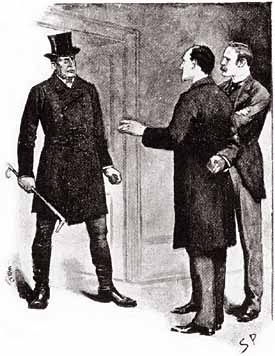
Arthur Conan Doyle’s “Sherlock Holmes: The Speckled Band” is a “locked room” mystery which sees the famed detective try to solve the mysterious death involving a “specked band” by the whim of Helen Stoner, who feels that her stepfather is attempting her murder so he can keep control of his inheritance. It is one of the best Holmes stories. There are many “wild” and foreign elements which are manifestations of the anxieties that most Brits felt of foreign Eastern elements intruding into their nation as a result of empire. Dr. Roylott is unable to get the East out of his mind, collecting Indian exports such as cigars and exotic animals, with even his temper changed. The gypsies near Roylott’s home serve as scapegoats for the crime as they are seen as outsiders associated with thievery and sinister elements. This reflects poorly on the doctor as they are the only people who will associate with him in Stoke Moran. But Roylott never truly controls his beasts, and this eventually leads to his demise.
Dr. Roylott has arrived in Britain in an Indian state of mind. Although his temper is hereditary, according to Mrs. Stoner “it had been intensified by his long residence in the tropics” (Doyle 2). This is supported by what happened in India to the doctor: there had been “some robberies which had been perpetrated in the house” and in his anger, “he beat his native butler to death” (Doyle 2). So even in Roylott’s time in India there are associations of that land with thievery and sinister-ness, since his property is taken from him there. After his imprisonment, Roylott returned to England with a cheetah and baboon. His daughters are troubled by this along with “the smell of the strong Indian cigars which it was his custom to smoke” (Doyle 3). The strong smell could be a metaphorical foreshadowing for what would later befall Julia, since both the cigar and the poison are strong. Later in the story, Holmes figures out that the swamp adder, “the deadliest snake in India”, was used in the killing because it would only “occur to a clever and ruthless man who had had an Eastern training” to use such a venomous animal (Doyle 11). Sherlock Holmes is suggesting that non-Western medicine and science is dangerous and evil in a way that Western medicine would not be. It is also mysterious since “the doctors examined her for it, but without success” (Doyle 4). This also associates the East with mystery and the unknown, playing on the anxiety and fear of many Brits during this time of elements in the east that are unfamiliar to them and potentially dangerous. The snake is a nice representation of Roylott: he is manipulative and cunning, wishing to kill his daughters but keeping it secretive. These qualities in the story are associated with India. There is an ironic parallel in the story: just as Dr. Roylott initially found medical success in India but was robbed, imprisoned and later became morose and disappointed, the Stoner sisters initially found happiness with Dr. Roylott before he secretly killed Julia, with Helen Stoner’s life being made worse. Dr. Roylott had been robbed in India, and now he is trying to rob his daughters of their lives and inheritance. The story makes the reader believe that India has changed Dr. Roylott.
Another element of the threatening exotic in this story are the “wandering gypsies” camping out on the land around Dr. Roylott’s house. Despite having been in Europe for centuries, Gypsies originate from the Indian subcontinent, and have been seen as outsiders and thieves by Europeans due to their nomadic and wandering way of life. This perception is in the story when Helen calls them “vagabonds” (Doyle 3). At first, the “speckled band” that is described by Helen is thought to be from the gypsies: she thinks that her sister’s words “may have referred to some band of people, perhaps to the very gypsies in the plantation”. She thinks it may refer to “the spotted handkerchiefs which so many of them wear over their heads” (Doyle 4). Sherlock Holmes comes up with a lead based on this confused interpretation of the word “band”. It is also notable that Dr. Roylott has “no friends at all save the wandering gypsies” and he would allow them to wander his grounds and “accept in return the hospitality of their tents, wandering away with them sometimes for weeks on end” (Doyle 2-3). Having lost his former social status and friends, and with no servants to help in his house, Roylott can only find companionship among this fringe group, which is presented in the story as further proof that Dr. Roylott is sinister and mysterious. Roylott has un-officially become a gypsy himself, another thing he adopted from India. Another parallel between Roylott and the gypsies are that both are presented as cunning, mysterious thieves. The night before Julia dies, she is troubled by a whistle that she hears, with Helen speculating that “it is those wretched gipsies in the plantation” (Doyle 3). Once again, the gypsy’s are the immediate scapegoats. While Dr. Roylott himself is the real culprit, the gypsies are only there to distract both the reader and Holmes, who later admits this himself. While the gypsies and Roylott are associated with India and the East, the story’s heroes are white British people. Also, while Holmes and Watson generally stay put in one place, the villains in the story are wanderers as well, even the exotic animals themselves. There is another contrast: while the gypsies and Roylott are lazy, the Stoner sisters have to do all of the housework and Sherlock and his companion labor to discover the culprit. The gypsies in the story work as mysterious, wandering and lazy elements.
But Roylott’s beasts, being wild, are unable to be tamed from the beginning. Due to his cheetah and baboon being able to wander freely around his grounds, they “are feared by the villagers almost as much as their master”. Roylott’s daughters lock the doors to their rooms every night, as they “had no feeling of security unless their doors are locked” (Doyle 3). Likewise, Dr. Roylott must keep his swamp adder in a locked safe despite his training of the creature with milk and his whistle. Even as he is as wild and venomous as it, he has no choice but to do this. But after Holmes turns on the light and attacks the creature, it is driven through the ventilator. This “roused its snakish temper, so that it flew upon the first person it saw” (Doyle 12). In a twist of irony, as Holmes puts it: “Violence does, in truth, recoil upon the violent, and the schemer falls into the pit which he digs for another” (Doyle 11). Even when they are tamed, animals like the swamp adder can still hurt or even kill. This brings into mind one of Aesop’s fables which involves the farmer taking in a snake who later bit and killed him (Aesop). It also warns of the dangers of appeasement: the person who appeases a crocodile will only be eaten last (Churchill). The swamp adder and the other animals are metaphors for the foreign Eastern people that many Brits felt could never be assimilated and made good British subjects, no matter how long they were controlled by Britain or how much they attempted to integrate them. There was this suspicion that India and the eastern colonies would rebel, and that Britain would be hurt by its Eastern colonies. Any provocation or spark could spell trouble with India, so the British had to be careful. Indeed, this was not without merit, as Britain faced a rebellion in India in 1857, forcing them to create the British Raj and directly control the country rather than the soft control they had before with the East India company (The Editors of Encyclopaedia Britannica). Just as the only way to control the snake was the lock-safe, the British felt that centralization and tighter control was the only way to secure and tame India. But even this would fail to keep India. No matter what he did, in the end Dr. Roylott could not tame his foreign, exotic pet.
So, it is seen that in reality the foreign elements that Dr. Roylott uses and their role in the story portray the anxieties that white Brits felt of the East and India. Roylott has returned with an Eastern state of mind and uses it to his advantage in his crime. The gypsies are scapegoats due to their associations with foreignness, the nomadic lifestyle and thievery. But at the end, even Dr. Roylott fell to the poisonous beasts of the east. This metaphorical reading of the story turns it from a simple and entertaining detective story into an allegory, one informed by many of the ideas and prejudices held in Britain about India and the East during the 1890s when this story was written. The author may be making a statement about the dangers of colonialism in the East, and it could also be seen as a warning to his fellow Brits telling them to be careful with how they engage with the East and not to bring anything dangerous back to the motherland.
Works Cited
Aesop. “The Farmer & the Snake”. Library of Congress Aesop Fables. n.d. Web site. 31 October 2020.
Churchill, Winston. The War Situation: House of Many Mnasions – International Churchill Society. 20 January 1940. Website. 31 October 2020.
Doyle, Arthur Conan. “Adventure of the Speckled Band.” 15 March 2014. The complete Sherlock Holmes. Document. 31 October 2020.
The Editors of Encyclopaedia Britannica. Indian Mutiny | History, Causes, Summary & Facts | Britannica. 4 May 2020. Web site. 31 October 2020.
 diegodelaparra
Leave a comment