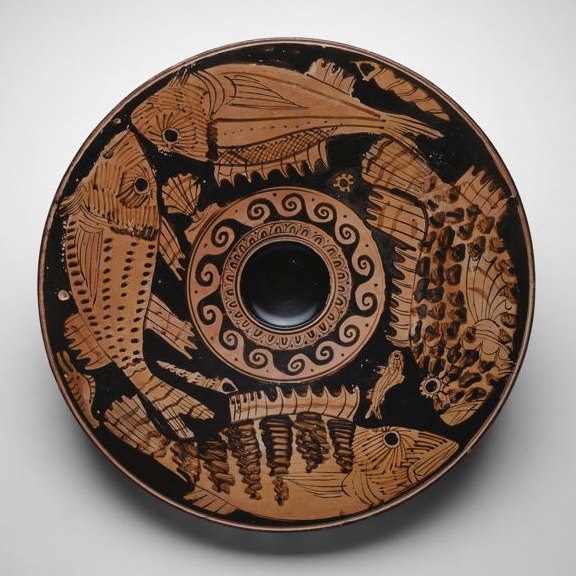
The first lecture by John Wilkins was on food in Greco-Roman Culture. Wilkins started out by talking about anthropological situations of food and culture in antiquity. The ancient Greco-Romans believed that nature was controlled by powerful forces, normally gods. I think this is a good point: many ancient cultures including the Greeks knew the world was unpredictable and they needed to ensure they would have secure food supplies, which they felt that they could achieve through placating the gods with plant and animal sacrifices. Vernant & Detienne in La Cuisine du sacrifice (1979) wrote that thigh bones and meat were important sacrificial components. This subject is seen in the dividing of the bull at Mekone by Prometheus: the gods were given the bones and humans the meat.
Prof Wilkins heavily cited Galen’s writings in the lecture. Galen warned that the food supply is not guaranteed, pointing out annual shortages. In many parts of the Mediterranean, food was short in the spring. Harvests were limited to a cycle which shaped the agricultural year and the sacrificial calendar. Temples such as the one of Athena in the Acropolis of Athens were places of animal sacrifice. Donors of food and drink were widespread in the Hellenistic period, and rulers gained prestige through donations. I know that also happened in the Roman world, and Roman emperors were expected to placate and gain the favor of their people through bread and circuses. Comedy was full of food. I think this is very interesting and agree: often in stories like comedies the Greeks would imagine better worlds, especially ones with lots of feasting, and food was important in Greek mythology. You see even divine foods like ambrosia. Feasting and eating were central, important parts of life both in the mythical and real worlds of antiquity.
Ancient medical science was wrong, and the average age was around 30. Treatment was often ineffective. However, there was a strong sense of the human being in the environment. One had to be in a ‘natural’ state with the body in balance. According to Galen, each individual has a different krasis, based on the theory of the 4 humours. This theory would be part of Western medicine up to the Middle Ages. Familiar and appropriate food, or oikeia such as the red mullet, was ideal. The best food was considered local, for example locally grown cereals. I do think that local food can often be better than imported food, because it is fresh, you may be more familiar with it and it can be healthier. It also takes less resources and food to transport it to people. In the modern world chemicals are also placed in imported food. It is interesting that the nutrition of the classical world is very similar to ours. I think that is because unlike medicine, which is more complicated and requires technologies for looking into the body and its organisms that did not exist back then, the subject of food and how it affects the body is much easier and requires less technology. The excavation of the Herculaneum sewer has confirmed many of Galen’s points about what the Romans would have eaten. The food came from shops and apartments, and there were many cereals, fish, nuts, vegetables, and fruits.
Wilkins concluded his lecture by pointing out that many food-friendly sources provide valuable evidence. The relation between nature and culture is thought provoking for our century. I do agree that the Mediterranean diet is healthy and is cited by leading authorities like UNESCO as such. But I wonder what Prof Wilkins meant by it being difficult to feed the population: I think that in general it would be difficult to always feed everyone in pre-modern societies, and I would imagine that the Mediterranean diet, having less meats and more grains, fruits and seafoods, might be at least a bit easier for feeding populations. Those in antiquity had both religious/mythical and ‘scientific’ perspectives on food, which I think well reflects such a people as the Greeks who relied on both types of perspectives. Communal feasting fostered an identity and wine was believed to be socially and medically beneficial. There were few recipe books: most recipes were drug mixtures and agricultural preparations. It was an interesting presentation but kind of rushed, and Prof Wilkins didn’t get to make all of his points. Wilkins’ presentation could also have been organized better and the different points and slides connected more.
Then Professor Lin Foxhall spoke about ‘ordinary’ household means and food preparation in ancient Greece. She cited a passage from Demosthenes, who had debts which is why Theophemos seized his property. I think the passage is important because it gives us some information on how the ancient Greek household was arranged and what people did there. Prof Foxhall then showed a reconstruction of the Dema House near Athens. It looks like a good representation of an upper-class Greek house. There was no kitchen inside, which was typical of all Greek houses. In summer you cooked outside and in winter inside. I think that would have made sense because of the seasonal weather changes. Common staple foods included flat bread and porridge. The little ovens that many Greeks had couldn’t produce enough bread. In cities there would be commercial bread. You would take your food to the commercial baker who was firing his oven up every day and pay him a small fee to cook bread or casserole. In Greek houses, you cooked in small batches, and cooking was constant since people ate in shifts. People ate on low tables and sat on stools or the ground. They ate with their fingers, as opposed to the later Romans who had cutlery and perfected the art of spoons, along with highchairs and tables. People ate food at room temperature.
Ritualistic dining was associated with animal sacrifice: while you may have cooked small bits of meat at home, you would only cook big batches as part of festivals, sacrifices, and celebrations. This connects to Prof Wilkins’ earlier points about the importance of food in relation to ritual, and even today we often save elaborate food for special occasions. Romans would differentiate status in food more than the Greeks. They elaborated food practices, had thick kitchens, and boiled their pots indoors all summer. I think this may have something to do with the fact that the Romans improved on the Greeks in some ways, being more practical which helped them become masters at engineering. There were different foods in different parts of the Greco-Roman world, but there were some common notions of food preparation, which spread with the Greco-Roman culture. In Asia Minor sauces like curry pastes were influenced by Middle Eastern foods. In southern Italy local Italic peoples adopted Greek cooking practiced but used their own for rituals. New varieties of foods were created like better sesames and dates.
Prof Foxhall finished by answering one of my questions on meat in the Greco-Roman world: In the ancient Mediterranean there were many animals and people liked meat. But even into the 20th century, people didn’t eat too much meat in traditional rural communities. They might eat it monthly in festivals. People’s protein mostly came from plants, and they also consumed a lot of dairy products. There were more sheep and goats, but cattle still existed, as did pigs in mountainous areas. She didn’t exactly answer my question on why people didn’t eat meat so often, but I think it was because it may have been more expensive back then and fish and plants would be cheaper and also easier to raise. Professor Foxhall believes that the way that people raised animals in the Mediterranean can teach us things about sustainability, and claimed that meat eating helps contribute to climate change. We can learn some things from them, but I’m not so sure that meat is such a big contributor to climate change. Humans have been eating meat for millennia, and while the population is much bigger now, I think farming practices still have negligible contribution, and farmers make sure that it doesn’t.
Then Prof Wilkins answered my question on recipes. Lots of ancient recipes were for fish. Fish was cooked in salt water with a few herbs, and simple flavorings were added to it. One famous recipe was the fermented fish sauce garum, which was like modern fish sauces in Southeast Asia. I have heard of garum before, and there were factories for it in places like Spain. Greeks and Romans normally mentioned silphium, which is used in some Indian dishes. Classic recipe ingredients and flavours were sought for, like asafoetida from India and Afghanistan. Indeed, exotic spices have always been sought for up until today and were a major drive in the European colonial period. The Greek’s connections with the East and their spread of Greco-Roman culture as far as India would have allowed them to obtain such spices.
I was impressed with the images that Professor Foxhall showed in her lecture including the Demos House of Athens and the Olynthos bronze brazier. It was a visual aid and went together well with her words. She also vividly described how cooking and eating would have taken place in the ancient Greek household. The modern world was referenced a few times, like Professor Wilkin’s comparisons between Greek and modern medicines, and the ancient Greek diet and the UNESCO Mediterranean, or Foxhall’s point on what ancient Greek practices can teach us on sustainability. But I felt that the modern world wasn’t really touched upon and that the speakers focused far more on food in antiquity. It may have been more helpful to reference the modern world more, perhaps comparing recipes or representations of food. I still learned things from both presentations and found them interesting.
 diegodelaparra
Leave a comment