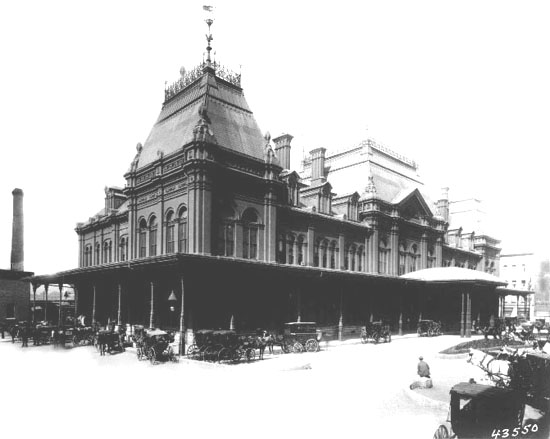
A large country such as Canada requires a strong railway industry for its transportation and economy. Four historical articles from Quebec’s English speaking media can tell us about the growth and development of the railway industry in Quebec and in relation to the rest of Canada, with citizens and the government being integral to this process. Montreal was crucial to the development of the railway industry in Canada.
The first article, from the Montreal Gazette’s May 8, 1874 edition, is by a concerned citizen writing under the pseudonym Britannicus, and gives us a contemporary glimpse into the development of railroads to the West. It comments on another recent article in the same newspaper by a Mr. Bloomsfield. This other article criticized Mr. Legge’s report favoring an extension of the Montreal Northern Colonization Railway, and alternately proposed the Huron and Ottawa railway. Britannicus points out that on the path of the HOR through the Ottawa Valley there is a ridge and the ground is rugged & rock ribbed, making railway construction disadvantageous. As an alternative Britannicus supports Legge’s proposed Northern Line MNCR route running through much more level ground hugging the bank of the Matawan River. Since it requires taxpayer money, Britannicus says that he has the right to advise against haste.[1] This article is one part of a lively debate taking place in the pages of the Gazette on the growing railway industry. The second half of the 19th century saw industrial growth in Canada, with Montreal’s industrial output rising to $77 million by 1871. Railways such as the St. Lawrence and Atlantic Railway and the Grand Trunk Railway were built. These projects were boons for Montreal’s merchants, increased Montreal’s connections across Quebec and even to the US and facilitated the development of small towns.[2] Montreal was at the centre of the railway industry. Montreal’s magnates now moved their focus to the West. This article also shows the importance of community input in the development of the railroad.
The next article is from the Montreal Herald’s May 8, 1899, edition, on the Incline Railway Company’s soon to expire lease. It shows a debate on how Montreal’s incline railway system should be managed. The IR is in Montreal and goes up the Mont Royal. The city under the current contract was set to remove the railway on December 31. The Herald’s opinion is that the city aldermen should take control of the railway as they think it would be better managed that way and it asserts that the people of Montreal agree. The article also has a number of interviews, and most favor reducing fares.[3] The article was written during Quebec’s Second Industrial Revolution. Quebec’s cities had recently shifted to tram railways, and Montreal’s streetcar system was switching from horsepower to electricity.[4] Tourism increased in Quebec to popular destinations like Montreal’s Mont Royal. But many could not afford the trip due to inequality and poverty. There was growing societal awareness of this problem and others such as public health. Among the initiatives that Montreal’s authorities took to combat health problems in children was organizing activities for them. A decade after the article was published, La Presse sponsored a series of summer picnics for children. These initiatives were supported by elites.[5] This spirit is clearly seen in many of the opinions in the Herald article. The expansion of Quebec’s cities created demand for urban infrastructure and services. A major debate was whether these should be profit-driven private enterprises or public utilities.[6] This question also expanded to governmental supervision of national railways.
Another article from the Sherbrooke Daily Record’s May 8, 1924, edition mentions how the Canadian National Railway had become a revenue producer for Canada since the government took control of it in 1917. G.M. Kyte, the M.P. of Cape Breton South and Richmond, touted the achievements of W.L.M King’s Liberal government since it came to power in 1921. He mentioned how the CNR had succeeded beyond the government’s expectations. The surplus of earnings over the cost of operating the railways was $21,187,462, with the deficit after removing the fixed charges greatly reduced. The total surplus was $30,409,109, and the public debt had been reduced by this amount.[7] The 1920s were a culturally and economically booming period for Quebec, called les années folles.[8] Free market economic liberalism dominated the province, and it pushed for attention to commerce, science and technology.[9] The Canadian governmental control of the CNR is an interesting exception to the rule. It had little choice but to seize control of the CNR due to the company’s bankruptcy, but it otherwise left private investors alone. The Canadian government integrated into the railway market. The Canadian railway industry had come a long way from its beginnings and flourished more than ever.
The final article is from the Montreal Gazette’s May 7, 1949, edition. It is about an announcement by G.A. MacNamara, vice president of traffic for the Canadian Pacific Railway in Montreal, about a boost in the railway’s western traffic, largely due to heavy grain and oil movements. Meanwhile there is a levelling off in the east. MacNamara attributes the booming Western traffic to large amounts of grain being shipped to the Pacific coast. MacNamara also points out that the proposed Edmonton-Regina oil pipeline may affect the railway’s oil-carrying enterprise, but that the project may engender new industries recompensing the company.[10] This shows how the railway business was booming more in Western Canada compared to the East. As a major farming centre, Western Canada provided grain shipped through the railway to other parts of Canada. Canada and the US had been spared WW2’s devastation and had prosperous economies. Montreal’s CPR could take advantage of this prosperity to enter new industrial markets like oil pipelines. In the postwar era, passenger travel in the trains declined and shifted to cars and trucks.[11] But this could have negative impacts too. Montreal’s black community was prominently represented in the railway industry of the city as porters, and these careers were a source of pride for the community.[12] This helped the development of the multiracial Little Burgundy neighborhood. But black employment declined with the railway industry, and neighborhoods like Little Burgundy were razed for new highways.[13] The decline of railway development was emblematic of larger technological and social shifts in the Western world.
The four articles show the development and growth of Quebec’s railway industry and its connection to the rest of Canada, with both the citizens and government integral to the process. They serve as a reminder that Quebec has been central to the economic development of the rest of Canada and that it was in the forefront of industries like the railway. This is not surprising for a founding province of Canada. Montreal for much of Canada’s history was the largest city of the country and a major economic centre.
Bibliography
Associated Press, “Claims C.N.R No Longer A Burden to Country,” Sherbrooke Daily Record, May 8, 1924, 12.
Britannicus. “Communications: Huron and Ottawa Railway.” The Montreal Gazette, May 8, 1874, 1.
Gossage, Peter, and J.I. Little. An Illustrated History of Quebec: Tradition & Modernity. Don Mills: Oxford University Press, 2012.
High, Steven. “Little Burgundy: The Interwoven Histories of Race, Residence, and Work in Twentieth-Century Montreal.” Urban History Review 46, No. 1 (Fall 2007): 23-44.
Minnett, Valerie and Mary-Anne Poutanen. “Swatting Flies for Health: Children and Tuberculosis in Early Twentieth-Century Montreal.” Urban History Review 36, No. 1 (Fall 2007): 32-44.
“Grain, Oil Shipments Boost West Traffic.” The Montreal Gazette. May 7, 1949, 18.
“Lease Will Not Be Renewed.” The Herald, May 8, 1899, 5.
[1] Britannicus, “Communications: Huron and Ottawa Railway,” The Montreal Gazette, May 8, 1874, 1.
[2] Peter Gossage and J.I. Little, An Illustrated History of Quebec: Tradition & Modernity (Don Mills: Oxford University Press, 2012), 113-15.
[3] “Lease Will Not Be Renewed,” The Herald, May 8, 1899, 5.
[4] Gossage, Quebec, 145-46.
[5] Valerie Minnett and Mary-Anne Poutanen, “Swatting Flies for Health: Children and Tuberculosis in Early Twentieth-Century Montreal,” Urban History Review XXXVI, No. 1 (Fall 2007), 35.
[6] Gossage, Quebec, 142.
[7] Associated Press, “Claims C.N.R No Longer A Burden to Country,” Sherbrooke Daily Record, May 8, 1924, 12.
[8] Gossage, Quebec, 193.
[9] Ibid, 184-86.
[10] “Grain, Oil Shipments Boost West Traffic,” The Montreal Gazette, May 7, 1949, 18.
[11] Steven High, “Little Burgundy: The Interwoven Histories of Race, Residence, and Work in Twentieth-Century Montreal,” Urban History Review 46, No. 1 (Fall 2007), 31.
[12] Ibid, 28.
[13] Ibid, 40.
 diegodelaparra
Leave a comment