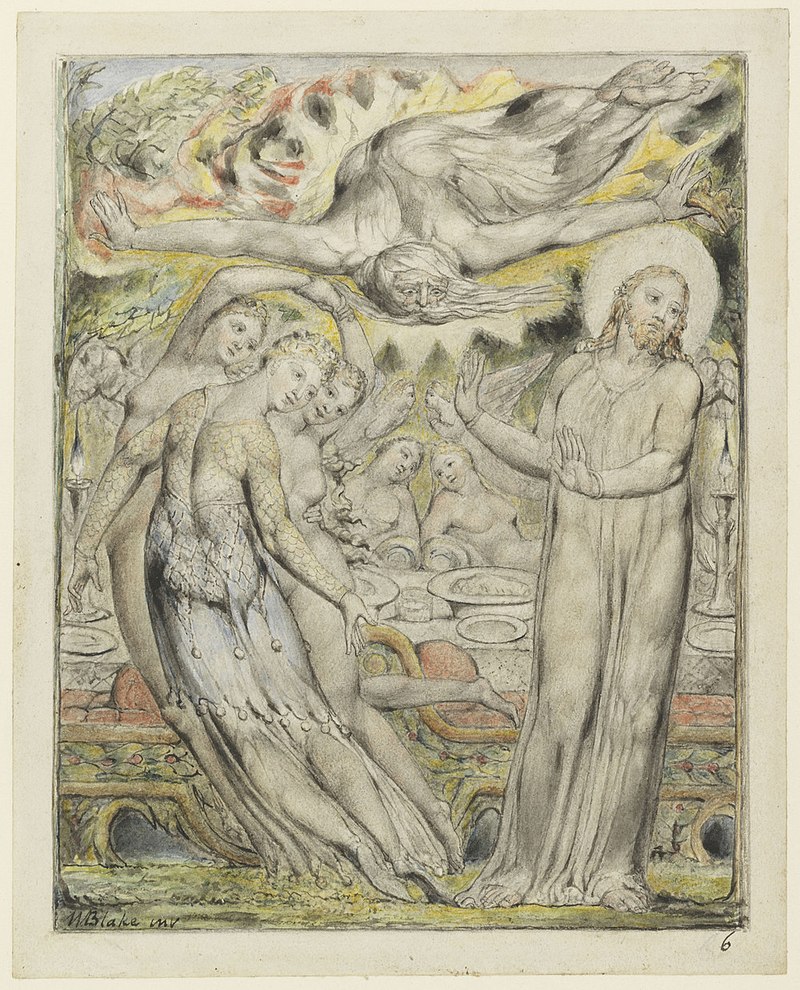
In John Milton’s Paradise Regained, Milton chooses the rather unexpected moment of Jesus’ retreat into the wilderness for Jesus’ greatest triumph: the regaining of Paradise. He portrays it as the antithesis to Adam and Eve’s temptation in Eden, and it is in this moment that Jesus is tempted with everything by Satan to take the easy path and turn back from his painful task, but Jesus resists and eventually defeats Satan.
Milton makes it clear from the beginning that Jesus’ temptation is an antitype to Adam and Eve’s:
By one man’s disobedience lost, now sing
Recovered Paradise to all mankind,
By one man’s firm obedience fully tried
Through all temptation, and the tempter foiled
In all his wiles, defeated and repulsed
And Eden raised in the waste wilderness. (Paradise Regained: Book I 2-7)
Jesus is clearly supposed to be Adam’s type, fixing what Adam failed to do. The wilderness symbolizes the degradation of Eden as the result of Adam and Eve’s sins. Jesus will be placed in the analogous position of being tempted by Satan, interestingly making him a more direct anti-type of Eve. Satan approaches Jesus in disguise, at the end of the 40 days. Satan has Jesus’ hunger to leverage, which he did not have with Adam and Eve because they had everything they needed. Jesus rejects Satan’s temptation to summon food, pointing out that only God can do so, and only God can choose when to feed himself. Satan makes a table appear with all sorts of foods, and it is pointed out “how simple, to these cates compared, / Was that crude apple that diverted Eve!” (Paradise Regained: Book II 348-49). Satan placing an entire banquet in front of Jesus makes this temptation more effective than the earlier one. All Jesus has to do is sit down. But Jesus refuses: “Shall I receive by gift what of my own, / When and where likes me best, I can command?” (Paradise Regained: Book II 381-2). Jesus can summon food and does not need Satan to do so. Jesus is also saying that his contemplation and meditation is more important than eating food.
Later Satan tells Jesus that he has the “duty to free / Thy country from her heathen servitude” (Paradise Regained: Book III 175-6). Here Satan is guilt trip Jesus by reminding him that Israel is under the rule of the Roman Empire and that Jesus must free his people from the Romans. But Jesus replies that he must be tested first, as “who best / Can suffer, best can do; best reign, who first / Well hath obeyed; just trial ere I merit / My exaltation without change or end” (Paradise Regained: Book III 194-7). Jesus rejects violence in establishing his kingdom, as his way is instead “by deeds of peace, by wisdom eminent, / By patience, temperance” (Paradise Regained: Book III 90-2). Jesus says that he must suffer this test and make sure he is ready before he can accomplish his task. While Jesus is perfect, this is in line with the idea of fixing yourself before fixing others and society. Satan later sends a tempest to torment Jesus while he is sleeping, foreshadowing the suffering that Jesus will face in his Crucifixion. Satan’s final test for Jesus is to cast himself off the top of the temple: saying that “Concerning thee to his angels, in their hands / They shall uplift thee” (Paradise Regained: Book IV 557-58). Jesus’ final reply is “Tempt not the Lord thy God” (Paradise Regained: Book IV 561). Finally, “Satan smitten with amazement fell” (Paradise Regained: Book IV 562). God is taken by angels to “a flowery valley” (Paradise Regained: Book IV 586). There is “set before him spread / A table of celestial food, divine, / Ambrosial, fruits fetched from the tree of life, / And from the fount of life ambrosial drink” (Paradise Regained: Book IV 587-90). This symbolizes the regaining of Paradise. This has been a debate, a verbal battle between Jesus and Satan, where Jesus had to defend his case and philosophy against Satan and discredit him. He needed to show that he would not submit to Satan no matter how easy it was to do so. Milton is writing about this because he wants to defend Jesus’ arguments for the faith against Satan’s temptations and strengthen the faith of his readers. By resisting and defeating Satan, Jesus showed that he was ready for the Crucifixion, and now nothing will stop him from carrying out his task.
Jesus’ time in the desert is the antithesis to Adam and Eve’s temptation in Eden, and here Satan offers Jesus everything to turn from his painful task, but Jesus, even in hunger and knowing all this, is unmoved by Satan’s temptations. This moment is when Jesus regains Paradise. Milton valued the contemplative life of seclusion, studying, prayer and meditation, and this work is a defense of that life.
 diegodelaparra
Leave a comment