My saint takes inspiration from many of the saints I’ve studied. I decided to choose St. Martin’s time and place for my saint because I found Martin’s life, his time period and his conversion of the pagans interesting. I wanted to create a saint with some similar experiences and qualities while having other ones. Like Martin, Hortensius was active in Gaul and served in the Roman army. But my saint is not a direct parallel of Martin. I wanted to make my saint start off as a pagan and commit sins, so that he could develop as a character, and have his conversion come through a vision similar to St. Paul’s. I feel that this aspect was lacking in the saints we have read, who appeared to be perfect; this may have been deliberate on the part of the authors because they were presenting these saints as models. My intended audience would be pagans to drive them to convert, and for recent converts to inspire them to persevere and grow in the faith.
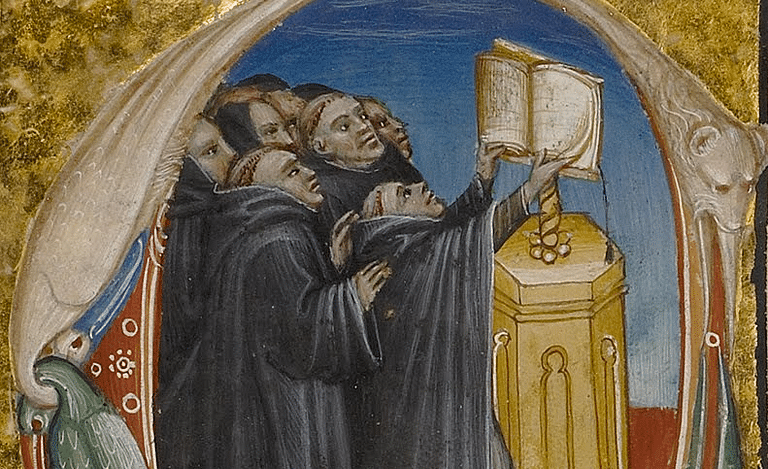
Hortensius’ pilgrimage to the Middle East and sojourn there was inspired by the two Melania’s journeys to that same place, and I also modeled Hortensius’ intellectualism and intense study of the Scriptures on Melania the Younger, who constantly read Scripture and made copies of them which she provided the saints with.[1] She inspired the intellectual regimen of Hortensius’ monastery, as she told her nuns even at her death to spend their lives “in the acquisition of perfect knowledge”[2]. Martin also had his monastery practice the craft of the scribes, which the younger ones engaged in while the older ones prayed.[3] The ideal of monastic life was to get closer to God, and one major way to do this was through intense study of Scripture, singing psalms or something else from it and producing manuscripts. I wanted to highlight this in Hortensius. Hortensius’ character is reflected in his monastery, which was a centre of knowledge and book production, like many monasteries in Europe. One example is the later monastic schools of Ireland, which were the most famed in Europe and crucial centres of book production.[4] This is one of my favorite and most interesting aspects of monasteries: they provided the best educations of their time and helped preserve a lot of classical knowledge after the fall of the Roman Empire.
Another monastic ideal Hortensius demonstrates after his conversion is self-control: not only with his intellectual pursuits, but he fasts strongly, and does not drink wine or eat anything sweet. The monastic lifestyle involved strong ascetism. Hortensius encountering the devil in the form of the beautiful woman is inspired by Anthony’s experience.[5] I wanted to use it to show the struggle that Hortensius faces with self-control to have him develop as a character. Hortensius’ inexperience contrasts with Anthony’s resistance. The part where Hortensius confesses to the hermit is taken from a parallel story in the Desert Fathers, where a young brother confesses his lust to the hermit and is wrongly rebuked.[6] I liked this story because it shows that monks had to be humble and help other monks who are having bad feelings like lust, because everyone can feel those temptations. Apollo encouraged the brother in the same way that Manuel encouraged Hortensius. Hortensius displays the virtue of obedience when he is told by Manuel to pray for help after being tempted by the devil and using the sign of the cross. I took Hortensius’ binding with chains directly from St. Radegunde, except instead of having it be a general ascetic practice as in her case, I wanted this to be Hortensius’ sacrifice specifically to save his children from the sickness.[7]
I wanted to show Hortensius converting the pagans as a parallel of St. Martin doing the same, while having original miracles: the burning of the altars was a direct inverse of Elijah’s challenge to Baal’s priests to request fire from their gods. Hortensius had to show bravery in trying to convert the pagans, another parallel with Martin, who nearly had a tree fall upon him, was injured at Leprosus and nearly struck by a pagan in a village of the Aedui.[8] St. Martin’s conversion of the pagans was one of my favorite parts of his story because of how central and important conversion has been in Christianity, while involving miracles which take faith to perform. It also shows that while Hortensius would spend much time living a contemplative life in the monastery, he would at times leave it and engage in active proselytization.
So I took inspiration from the lives and qualities of many of the saints I have studied while crafting my own. I wanted to combine them into one person while adding some of my own original contributions.
Bibliography
Athanasius of Alexandria. The Life of Anthony. In Early Christian Lives, ed. trans. Carolinne White. London: Penguin Classics, 1998. pp. 3–70.
C. H. Lawrence. “Wandering Saints and Princely Patrons”. In Medieval Monasticism: Forms of Religious Life in Western Europe in the Middle Ages. 4th edition. New York: Routledge, 2015. 36-49.
Gerontius. “The Life of Melania the Younger.” In Handmaids of the Lord: Contemporary Descriptions of Feminine Asceticism in the First Six Christian Centuries. Ed. and trans. Joan M. Petersen. Trappist, KY: Cistercian Publications, 1996). 299-310 and 311-361.
Sulpicius Severus. “The Life of Martin of Tours.” In Early Christian Lives. 134-159
Selections from Benedicta Ward, trans., The Desert Fathers: Sayings of the Early Christian Monks. New York: Pengin, 2003. 8–11, 19–25, 33–37, 140–147.
Venantius Fortunatus. “The Life of Saint Radegund.” In Handmaids of the Lord. 381-400.
[1] Gerontius, “The Life of Melania the Younger”, in Handmaids of the Lord: Contemporary Descriptions of Feminine Asceticism in the First Six Christian Centuries, ed. and trans. Joan M. Petersen (Trappist, KY: Cistercian Publications, 1996), 328.
[2] Ibid, 355
[3] Sulpicius Severus, “The Life of Martin of Tours” in Early Christian Lives, 144
[4] C. H. Lawrence, “Wandering Saints and Princely Patrons”, in Medieval Monasticism: Forms of
Religious Life in Western Europe in the Middle Ages. 4th edition (New York: Routledge, 2015), 41.
[5] Athanasius of Alexandria, The Life of Anthony, in Early Christian Lives, ed. trans. Carolinne
White (London: Penguin Classics, 1998), 12.
[6] Selections from Benedicta Ward, trans., The Desert Fathers: Sayings of the Early Christian
Monks (New York: Pengin, 2003), 33–35.
[7] Venantius Fortunatus, “The Life of Saint Radegund” in Handmaids of the Lord, 392.
[8] Severus, “Martin of Tours”, 146-8.
 diegodelaparra
Leave a comment