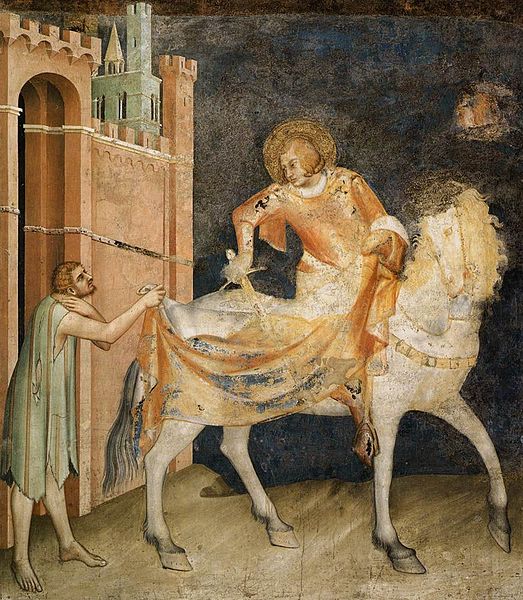
St. Martin of Tours was one of the central saints of the medieval monastic tradition. He had been a soldier, monk, and then bishop of Tours in his lifetime. This essay argues that because Martin was portrayed as the exemplary miles Christi or warrior for Christ in his monastic biography, he was an ideal for both knights and ecclesiastics in the late Middle Ages. Martin’s combination of the contemplative ascetic and the active preaching lives inspired St. Francis of Assisi and his mendicant order. Martin’s stand for spiritual against temporal power inspired ecclesiastics when they struggled against secular power. Later, St. Martin became a chivalric ideal because his portrayal as a spiritual warrior was reinterpreted into that of a temporal knight. St. Martin’s many aspects made him an exemplary saint in the Middle Ages.
The miles Christi metaphorically described the life and service of the Christian as military service and battle. It started out as metaphorical, denoting the service of monks and bishops.[1] Martin encompassed the ideal through balancing the active and contemplative lives as monk and bishop. He had ascetic tendencies even before becoming a monk. When forced to join the Roman army, Sulpicius Severus described how Martin “brought help to the wretched, he fed the poor, he clothed the naked and kept nothing of his military salary for himself apart from what he needed for food each day”.[2] Possibly the most famous episode of Martin’s life was when he encountered a naked beggar at Amiens. He promptly “divided [his] cloak in two [and] gave half to the beggar”. The next night Martin saw Christ clothed in this same cloak piece. [3] Martin displayed the monastic ideal of charity, helping others even at the expense of his own property. Martin did not have anything else to cover the beggar with but half of his own cloak. After leaving the army, Martin went to study with Hilary, bishop of Poitiers, and was made an exorcist.[4] Martin spent much time in the solitary life as a monk: he lived in a cell in Milan and withdrew to the island of Gallinara when persecuted by the Arians, surviving poisonous hellebore through prayer.[5] Even when elected bishop of Tours, Martin took the role “without abandoning his monastic commitment and virtue”. He stayed in a cell two miles outside the city with eighty disciples and founded Marmoutier.[6] But Martin simultaneously preached, converted, and performed miracles out in the world. Shortly after leaving the army, he returned to his native Pannonia to convert his parents, converting a brigand on the way by “preaching the word of God to him”. He successfully converted his mother and a few others, though his father stayed pagan. Martin preached relentlessly against the Arians. Through prayer he resurrected both his catechumen and a young slave who had hanged himself.[7] Martin preached to the pagans of Gaul, and while he destroyed their temples and holy trees, he usually converted them “by means of his holy teaching”, and they destroyed their temples themselves. Martin healed a dying girl at Trier through praying and pouring oil in her mouth before touching her.[8] Martin was thus a model of the bishop-monk, who “uncompromisingly maintained the rigorous virtue of the religious life but, atypically for a monk, simultaneously did great things outside the monastery”.[9] Severus contrasted Martin with the Desert Fathers: they left behind the world and all of its distractions to focus on sanctity, while Martin stayed in the secular world, and had to deal with its temptations and distractions while pursuing sanctity. This made him more impressive.[10] This may have something to do with their different environments: the Near East and Egypt were the earliest centers of Christianity. In contrast, Gaul was more pagan, and ripe for conversion. Martin was a saint who balanced both ascetism and preaching and represented a shift from the contemplative to the active life. Severus emphasized that Martin’s different roles were essential aspects of him and carried on for his whole life. Martin’s goal was to convert and extend the community of believers. Both the catechumen and the young slave were spiritually at risk: the former had not been baptized and the latter hanged himself, but Martin saved both their souls.[11] Martin triumphed as a saint by facing challenges head-on rather than avoiding them.[12] He spent time in the contemplative world to prepare for active ministry and preaching.
Francis of Assisi 800 years later was directly inspired by Martin. Like Severus, Thomas of Celano wrote Francis’ biography as an apologetic for the active life.[13] Francis was both an individual who embraced “contempt of the world, and the abnegation of one’s proper will” and a public figure sent for the “salvation of the world”.[14] After joining the monastic life, Francis lived a solitary lifestyle of asceticism: he withdrew to a grotto with his companion and prayed for God to “direct his way and teach him to do his will”.[15] Francis rebuilt the church of St. Damian which he offered to his companion Clare for her order of nuns. Francis also had his moment where he embraced the active in addition to the contemplative life: when he heard the Gospel of “how the Lord sent his disciples out to preach”, Francis resolved to follow a frugal life of preaching, wearing “a tunic bearing a likeness to the Cross”.[16] Francis created the Order of Friars Minor and went about “preaching peace, teaching salvation and penance unto the remission of sins”. The people flocked to him.[17] Unlike Martin, he was not converting pagans but waking up Christians from spiritual sleep. But like Martin, Francis started out in the most secular occupation of his world, as a merchant, and as a missionary sold people the idea of divesting from the physical world and investing in the heavenly.[18] Even Martin’s most celebrated action of dividing his cloak was paralleled in Francis: once he “donated his cloak to an impoverished knight”. Thomas of Celano hailed him as a “new St. Martin”.[19] Francis appropriated Martin as a hero of his Franciscans. But the two saints were different in that Martin was a model of constancy: he had made the decision from the beginning to join the Church and lived frugally and poorly.[20] Francis lived lavishly, “squandered and wasted his time miserably”.[21] Francis had to go through a period of personal change: first he suffered anxiety and illness, and then dreamed of weapons filling his house, ending his desire for military glory, and gradually drawing him towards the gospel.[22] The way the two hagiographers presented their saints reflected their goals: Severus presented Martin as a model of constancy and perfection to show him as an ideal for Christians to follow and to engender total devotion. Meanwhile, Thomas made Francis more relatable to lay people by showing his flaws and personal change: telling his followers that Francis was human like them, rather than someone far removed. Even as they started from different places, Martin and Francis balanced the contemplative and active lives.
Martin showed the superiority of spiritual over temporal power, providing a model for church administration and the church’s struggle against secular powers. As a miles Christi, Martin had loyalty to God alone. If the will of God conflicted with that of a secular power, the miles Christi had to choose God. In the battle against the barbarians at Worms, Martin defied Julian in refusing to fight and requesting his discharge.[23] Martin was the sole bishop to defy imperial authority: he “refused to dine with Maximus” when multiple bishops came to dine with the emperor, criticizing him for overthrowing Valentinian II and killing Gratian.[24] When he was given the libation bowl, Martin handed it to the priest instead of the emperor. Martin predicted that if Maxentius fought against Valentinian in Italy “he would be victorious in the first onslaught, but he would die shortly afterwards”. Martin’s prediction came true: Valentinian fled from Maximus but then a year later Valentinian captured and killed Maximus outside the walls of Aquileia.[25] Martin was willing to stand up to the emperors and tell them the truth. This made him an inspiration to the church when it struggled against secular powers. One example reflecting this is Martin’s portrayal in the Lower Basilica of San Francesco in ten frescoes by Simone Martini. This chapel was commissioned by Cardinal Gentile da Montefiore dell’Aso in 1312.[26] St. Martin would have appealed to the Cardinal because he had just returned from Hungary where he argued for the Angevin Charles’ right to the Hungarian throne, and St. Martin was the Angevin patron saint.[27] Three scenes are dedicated to Martin’s engagements with emperors. In the third scene the emperor, Valentinian in this case, kneels and embraces Martin after he is burned by his throne’s flames.[28] These scenes were responses by Martini to contemporary political struggles: the Holy Roman Emperor Henry VII challenged the church’s authority and invaded Italy.[29] The emperor denied that the oath he swore at his coronation bound him to serve the pope.[30] This was part of a long political struggle between the Guelphs and Ghibellines: the former believed the Pope had the right to rule Italy and the latter believed the emperor did. St. Martin was a perfect figure to exemplify the superiority of spiritual over temporal power.
Martin fought for unity in the church against the Arians: he was “almost the only one to fight most strenuously against the heretical beliefs of the priests”.[31] Martin struggled against some members of the church hierarchy: during his election as bishop of Tours, some other bishops disliked him because of his “scruffy appearance, dirty clothes and unkempt hair”.[32] Martin also led his monks at Marmoutier in a rigorous, strict lifestyle: the art practiced there was “that of the scribes; the young were set to this task while the older ones spent time in prayer”. Martin had them wear only camel-skin garments and receive food together after fasting. They did not leave their cell except for common prayer. Many had been noblemen but voluntarily accepted this lifestyle.[33] These aspects of Martin as holy leader inspired later church figures. Odo of Cluny focused on Martin’s total response to God’s call and withdrawal from the values of his society and family, as he wanted his own monks to do the same. Odo also valued Martin’s prayer, poverty, self-discipline, and his leadership of his monks in this lifestyle.[34] Jacobus de Voragine focused on Martin as a bishop and leader of the church. His Legenda Aurea de-emphasized Martin’s inner qualities, like his goals, attachments, and emotions. For example, Martin unhesitatingly split his cloak, and there were no onlookers to congratulate Martin’s sacrifice or make fun of his appearance. Martin was also detached from his historical context as secondary references were removed from Jacobus’ narrative, making it a laundry list of feats that Martin performed. The Arian heresy became an abstract menace that Martin appeared to confront alone. All suggestions of conflict and controversy in the church were removed.[35] Martin exchanged lower states for higher ones: from lay soldier to monk then bishop, and then Jacobus ignored previous states. Jacobus’ message in his sermons was that the lay Christian had to adhere to one of the lay, monastic, and episcopal ideals perfectly exemplified by Martin.[36] Jacobus was an administrator for the Dominican Order in 13th century Lombardy, a center of heretics claiming they were the descendants of the Apostles.[37] Jacobus reinterpreted Martin to engender piety and combat these preachers by focusing on the saint as an extraordinary, heroic and almost superhuman figure. He was using Martin as a unifying figure to bring people back to the orthodox faith and make them obey the ecclesiastical authority. Martin’s return from the exile imposed by the Arians, his high positions in the church and his conversion of many pagans recommended him to Jacobus. So Martin’s roles as monastic abbot and bishop were other aspects of him as miles Christi and made him a symbol of ecclesiastical authority and power.
Martin was also a chivalric ideal in the Middle Ages, despite Severus repudiating the military ideal in his hagiography and Martin leaving the Roman Army. The association was already there: the miles Christi defined monks and bishops as “soldiers of God”, and their monasteries were often compared to fortresses. Severus made the association many times: when Martin refused to fight against the barbarians at Worms, he called himself a “soldier of Christ” and said: “with neither shield nor helmet but with the sign of the cross to protect me, in the name or the Lord Jesus I will push my way into the enemy’s formations”. The enemy later surrendered.[38] Martin displayed bravery many other times in his life: when converting the pagans, he destroyed an ancient temple and then volunteered to stand in the path of a tree the pagans cut down. As the tree fell Martin “made the sign of salvation to block the tree’s path. As a result the tree fell in a different place”. At a village of the Aedui a pagan aimed a blow at Martin, who “offered his bare neck”, but then the man fell back.[39] Martin expelled demons a number of times: once when he entered a house a demon had thrown it into confusion, but Martin put his own fingers into the mouth of the possessed cook, and “as if it had received white-hot metal in its jaws”, the demon fled in a “flow of diarrhoea”. Martin dispelled a rumor of a barbarian invasion of Trier by forcing a demon possessing a man to confess.[40] Martin struggled against the devil and resisted him through the sign of the cross and prayer. At one point the devil disguised himself as a young man named Anatolius and tried to convince the monks of Marmoutier that he was a saint, but the suspicious monks dragged him to Martin, and the devil’s white tunic disappeared.[41] Martin engaged in battles throughout his life, even if they were not strictly military, and he protected his monks and normal people from the predations of demons and the devil.
The miles Christi ideal of the spiritual warrior was reinterpreted into a literal one starting with Odo of Cluny. Odo was a canon at St Martin’s Church in Tours. In his Life of St. Gerald of Aurillac Odo described Gerald as a model holy warrior who won battles without spilling blood: like Martin, he had the virtues of “charity, patience, humility, and abstemiousness”.[42] During the pontificate of Gregory VIII, the definition of miles Christi expanded to cover knights and crusaders. [43] With the onset of the Crusades, figures like Pope Urban II, Bernard of Clairvaux, and Alan de Lille encouraged knights to practice both spiritual and physical warfare.[44] By the 12th century Martin was featured as a stouthearted Christian knight in the chansons de geste. Pean Gatineau’s La Vie Monseignor Saint Martin De Tors recounted events from Martin’s life including his investiture as a knight by the Roman Emperor. While this episode never occurred, it was a common feature of medieval hagiography to engage in these anachronisms. This episode is depicted in a scene at the same Lower Basilica of San Francesco, the Investiture of St Martin as a Knight, indicating that Simone Martini may have known of Gatineau’s work. A knight’s investiture celebrated his transition from puberty to adulthood and was analogous to a baptism where a neophyte became a Christian. Thus, in the Investiture scene, Martin really dedicates himself to Christ. By this time a knight’s vesting had religious associations.[45] There is a direct parallel to a mural of Francis in the upper basilica, St Francis Renouncing Worldly Goods. There, the saint casts off his clothes and is enveloped with a cloak by the Bishop of Assisi to protect him from his father’s wrath. Martin and Francis in their murals stand in the same devout manner, their hands lifted in prayer and looking at the sky, and both dedicate themselves to the Church. Francis of Assisi admired knights, and at times called his followers his “Knights of the Round Table”.[46] More media from the period depicts Martin as a knightly miles Christi. A 13th century hymn to St. Martin portrayed him as a spiritual warrior fighting the war “between flesh and spirit in ashes and sackcloth”.[47] The late medieval Miles more probiatis sequence portrayed Martin as a knight. The rhyme scheme of the poem shifts from Martin as a soldier and saint in his own life to the patron of contemporary devotees.[48] Martin was invoked as a protector against demons and devils. The reinterpretation of the miles Christi as a knight resulted in Martin’s reinterpretation as a chivalric ideal.
Martin’s portrayal as the exemplary miles Christi in his monastic biography made him a knightly and ecclesiastical ideal in the late Middle Ages. Martin’s balancing of the active and contemplative lives as monk along with his reinterpretation of the ideal of sanctity made him a model for Francis and his mendicants. Martin’s defiance of Roman Emperors made him an ideal for ecclesiastical authority. And Martin’s brave battles against paganism, demons and the devil made him a chivalric ideal. Martin continued to be a central saint long after the Middle Ages: his cult was revived in late 19th century France to engender national patriotism, and he was also claimed as a Hungarian national hero. St. Martin’s Day is still celebrated today on November 11.
Bibliography
Christof Brennecke, Hans. “Miles Christi (Soldiers of Christ).” In Religion Past and Present, 2011, Brill.
Cassidy, Brendan. “Simone Martini’s ‘St. Martin and the Emperor’ and Contemporary Italian Politics.” Zeitschrift fur Kunstgeschichte 70, no. 2 (2007): 145-58.
Coakley, John W. “The Conversion of St. Francis and the Writing of Christian Biography, 1228- 1263.” Franciscan Studies 72, (2014): pp. 27-71.
Hoch, Adrian S. “St Martin of Tours: His Transformation into a Chivalric Hero and Franciscan Ideal.” Zeitschrift fur Kunstgeschichte 50, no. 4 (1987): 471-82.
Maurey, Yossi. “From pacifist to knight: late medieval appropriations of St. Martin.” In Medieval Music, Legend and the Cult of St. Martin, 206-246. United Kingdom: Cambridge University Press, 2014.
Reames, Sherry L. “Saint Martin of Tours in the Legenda aurea and before.” Viator 12 (1981): 131-64.
Rosenwein, Barbara H. “St. Odo’s St. Martin: the uses of a model.” Journal of Medieval History 4 (1978): 317-331
Severus, Sulpicius. “The Life of Martin of Tours.” In Early Christian Lives. 134-159.
Wolf, Kenneth Baxter. “St Francis and Early Christian Sanctity.” In The Poverty of Riches: St. Francis of Assisi Reconsidered, 47-68. United Kingdom: Oxford Scholarship Online, 2003.
[1] Hanns Christof Brennecke, “Miles Christi (Soldiers of Christ)”, in Religion Past and Present, 2011, Brill.
[2] Sulpicius Severus, “The Life of Martin of Tours,” in Early Christian Lives, 137.
[3] Ibid, 138.
[4] Ibid, 139.
[5] Ibid, 141.
[6] Ibid, 143-4.
[7] Ibid, 140-2.
[8] Ibid, 146-9.
[9] John W, Coakley, “The Conversion of St. Francis and the Writing of Christian Biography, 1228-
1263,” Franciscan Studies 72, (2014): 33.
[10] Kenneth Baxter Wolf, “St. Francis and Early Christian Sanctity” in The Poverty of Riches: St. Francis of Assisi Reconsidered (United Kingdom: Oxford Scholarship Online, 2003), 55.
[11] Sherry L. Reames, “Saint Martin of Tours in the Legenda aurea and before,” Viator 12 (1981):
133-6.
[12] Ibid, 138.
[13] Wolf, “St. Francis”, 63.
[14] Coakley, “Conversion”, 34.
[15] Thomas of Celano, “The Life of St Francis of Assisi” in Medieval Saints: A Reader, ed. Mary-Ann Stouck (Peterborough: Broadview, 1999), 476.
[16] Ibid, 480-1.
[17] Ibid, 486.
[18] Wolf, “St. Francis”, 66-7.
[19] Adrian S. Hoch, “St. Martin of Tours: His Transformation into a Chivalric Hero and Franciscan
Ideal,” Zeitschrift fur Kunstgeschichte 50, no. 4 (1987): 479.
[20] Ibid, 482.
[21] Celano, “Life”, 471.
[22] Ibid, 472-3.
[23] Severus “Martin”, 138-9.
[24] Ibid, 152; 217
[25] Severus, “Martin”, 152-3.
[26] Brendan Cassidy, “Simone Martini’s ‘St. Martin and the Emperor’ and Contemporary Italian
Politics,” Zeitschrift fur Kunstgeschichte 70, no. 2 (2007): 145.
[27] Ibid, 147-8.
[28] Ibid, 150.
[29] Ibid, 152.
[30] Ibid, 155.
[31] Ibid, 140-1.
[32] Ibid, 143.
[33] Ibid, 144.
[34] Reames, “Legenda”, 142-3.
[35] Ibid, 148-9.
[36] Ibid, 154-5.
[37] Ibid, 163.
[38] Severus, “Martin”, 138-9.
[39] Ibid, 147-8.
[40] Ibid, 150-1.
[41] Ibid, 154-6.
[42] Barbara H. Rosenwein, “St. Odo’s St. Martin: the uses of a model,” Journal of Medieval History
4 (1978): 326.
[43] Yossi Maurey, “From pacifist to knight: late medieval appropriations of St. Martin” in Medieval Music, Legend and the Cult of St. Martin (United Kingdom: Cambridge University
Press, 2014), 207.
[44] Ibid, 213.
[45] Hoch, “St. Martin”, 475-7.
[46] Ibid, 481.
[47] Maurey, “Knight”, 218.
[48] Ibid, 222.
 diegodelaparra
Leave a comment