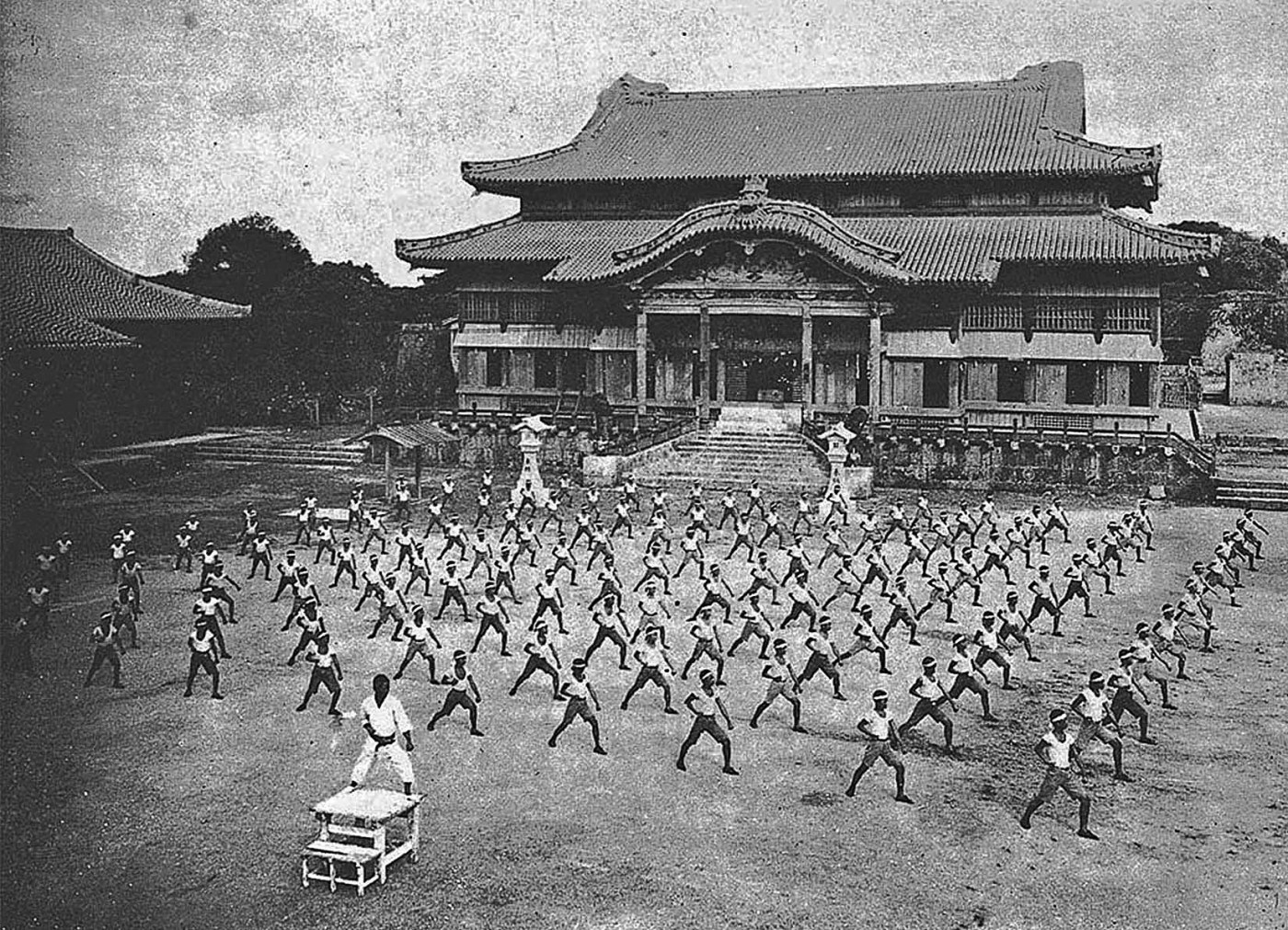
(In memory of the late Hanshi Scott Hogarth, a great friend and teacher)
Goju-ryu is a karate style from Okinawa, one of Japan’s Ryukyu Islands. It was founded by Chojun Miyagi in 1930, but its roots go back to his master Higaonna Kanryo, creator of the Naha-te style. Goju’s main kata or form, Sanchin, is made up of occult secrets and principles that one can spend a lifetime learning. The style’s basic techniques are tsuki (punching), uke (blocking), and geri (kicking). Its fighting techniques include blows to the joints, throws to the floor, and chokes. However, according to one of Goju’s most famous sayings, the style is about “not being hit by others and not hitting others”. That is, a practitioner must adhere to the non-aggression principle and cannot initiate fights, but must be ready to defend themselves if necessary. Regular training in Goju creates a sound mind and a healthy, strong body that never backs down. The style’s katas are divided into “Heishu” (closed hand) and “Kaishu” (open hand). The original Goju curriculum has 12 katas.[1] However, the curriculum in Canada has been significantly modified to tailor to students.
Naha-te: The Root of Goju
Higaonna Kanryo was born on March 10, 1853.[2] It is said that Kanryo committed to learning martial arts when a tea merchant who he saw as a father figure was beaten and mugged.[3] As a child, he started training in Shuri-te, a type of te (hand) Okinawan martial art. He also learned the Luohan style from Arakaki Seisho, a translator for the Ryukyu Kingdom’s court.[4] However, Kanryo’s 1869 trip with the same tea merchant to Fuzhou in China’s Fujian province was crucial to his development of Naha-te. The merchant sent Kanryo to stay with Lu Chin Woo, a master of the Fujian White Crane style.[5] In 1870, Arakaki went to Beijing for work, and recommended Kanryo to Kojo Taitei, who became his new teacher. Kanryo went back to Fuzhou in 1873 and continued training in Chinese martial arts. In 1877 he became a student of Ruruko, the creator of Whooping Crane Kung Fu whose Chinese name was Xie Zhongxiang.[6]
In 1882 Kanryo returned to Okinawa and created Naha-te by combining te with the go-no (hard) and ju-no (soft) kenpo techniques he had learned in China. The Nanpa Shorin-ken kung-fu style also influenced Kanryo.[7] He changed the original kenpo open hands to closed fists to create Sanchin.[8] After the Sino-Japanese war, Japan annexed Okinawa, and the other masters of Naha-te moved to China since their pro-China stance lost them power in Okinawan politics. However, Kanryo stayed and taught Naha-te privately in his home.[9] Kanryo expanded the style’s reach by teaching it in educational institutions like Naha’s public business school, where police learned it. Among his students were creators of other martial arts styles like Juhatsu Kyoda of the Toon-ryu school and Kenwa Mabuni of the Shito-ryu school.[10]
Chojun Miyagi’s Coming of Age
Kanryo’s most famous student was Chojun Miyagi, born on April 25, 1888, who began training in Okinawan martial arts (bujutsu) at age 11. At 14 he entered Kanryo’s tutelage. Miyagi patiently followed his master’s strict regiment, developing mental strength, the correct breathing rhythm, and a strong, resilient body.
In December 1910, Miyagi entered compulsory military service for 2 years in Miyakonojo, Miyazaki Prefecture. While the training was tough, the school’s head recognized Miyagi’s martial arts acumen and had him instruct his fellow soldiers. Miyagi also became a military medical assistant, and enrolled in Miyakonojo’s dojo to immerse himself in judo.
Following Kanryo’s advice, Miyagi visited Fuzhou in May 1915 to find Ruruko or his disciples. Miyagi found his tomb but not the disciples. In October 1915, Kanryo died at Miyagi’s house aged 63. Miyagi returned to Fujian in 1917. There, he obtained the book “Bubishi” which gave him a new martial arts vision, and that book’s 6 precepts, along with the Rokkishu form from the Fujian White Crane style, inspired his closed hand kata “Tensho”.[11]
The Birth of Go-Ju Ryu
In the 1920s, Miyagi started developing his Karate style. In 1922 he taught at Okinawa’s police school and in 1926 founded the “Okinawa Karate Club” after a meeting with karatekas in Naha.
In 1927, Miyagi taught Karate in mainland Japan for the first time at the invitation of the Imperial University of Tokyo. That same year, Kano Jigoro, the founder of judo, was invited to Okinawa for the “Association of Karatekas with the Title of Dans of Okinawa”. There, Miyagi demonstrated his martial art to Kano, who was impressed by it. Kano recommended that Miyagi go to the 1930 “Competition of Martial Arts Katas Dedicated to the Meiji Sanctuary”. Taking Miyagi’s place, Jin-An Shinzato demonstrated the “Sanchin” kata. A Japanese martial artistasked for the style’s name, and Shinzato responded with hanko-ryu (half-hard style).[12]
Afterwards, Miyagi formally came up with Goju-ryu (hard-soft style), from a line in the Bubishi poem Hakku Kenpo or “The Eight Laws of the Fist” that says “everything in the universe inhales soft and exhales hard”.[13] The poem describes everything in the universe as having opposites: “light and dark, male and female, hardness and gentleness”.[14] Reflecting the nature of his martial art, Chojun Miyagi balanced his great strength with serenity. He could perform incredible feats, as he showed in a demonstration in his native land. First, he reached into a bundle of bamboos and ripped one from the centre. Then he put chalk on his feet and kicked the ceiling, marking it with his footprints. People hit Miyagi with a bo staff, but he did not budge. He then ripped bark off a tree. Finally, he kicked a hole in a kerosene can with his big toe. Miyagi told the audience: “Any karate expert who trains properly can do all of this. It is simply a matter of paying the price. Karate is total commitment. I have not done anything that someone else cannot do, or, for that matter, you. There is no halfway measure. Either you do it or you don’t. Nothing is impossible!”.[15]
In 1933, the martial art was registered as “Karate of the Go Ju School” in the Association of Japanese Martial Arts and in the next year a branch of this association was established in Okinawa, with Miyagi as its regular delegate. He was recognized by the “Shoken-kai” of the Ministry of Education for his contribution to Japanese athletics. In 1934, the manager of the Hawaiian newspaper “Youenjihousya” and the members of Okinawa’s prefectural association Kenjinkai invited Miyagi to a karate conference in Hawaii to demonstrate the martial art and instruct the police. In 1935, some of Miyagi’s disciples like Jituei Yogi and Gogen Yamaguchi created a study club in the University of Ritumei to spread karate in the Japanese mainland.[16]
The Codification of Goju-ryu
In a January 1936 Osaka conference Miyagi stressed the need to develop karate’s self-defense techniques and create competitions to spread the martial art. He also commented on the spirituality of Japanese budo or martial arts. On October 25th of the same year, he attended a formal talk in Naha organized by the press organization Ryukyu Shinpou, where he helped formalize the name of karate from 唐手, meaning “Chinese/Tang hand”, to 空手, meaning “open hand”. This change was implemented to break the martial art from its Chinese roots in this time of rising Japanese nationalism and develop it in a more Japanese flavor. Miyagi mentioned that the te styles were the root of Okinawan martial arts, and proposed creating new katas while keeping the classical ones. He made these comments about his style: “When they ask me to classify the schools, I can do it by their method of instruction. On one side there are the unorganized schools that teach basic and open katas in a mixed order. On the other there are those which have well systematized, organized instruction, clearly differentiating basic and open katas. My master’s is part of the second group”.[17] This shows how Kanryo’s Naha-te style was already sophisticated in its structure, and how Miyagi built on his master’s foundation while making his own original contributions to develop and formalize Goju.
It should be noted, however, that Miyagi’s dojo lacked set, organized classes: students simply trained on their own time. If another student was present, the two trained together. Instruction was done individually. [18] The Japanese introduced group classes and the judo belt system to Goju. To provide incentives for training, they added other belts like yellow, blue, and green to the original three white, brown, and black belts from judo.[19]
In 1937, Miyagi earned the honor of first instructor in karate from the Japanese Martial Arts Association. He exerted great effort in promoting karate to the public. In 1940 he created two katas, “Gekisai Dai-Ichi” and “Gekisai Dai-Ni”.[20]
Wartime Blues and Postwar Development
World War II interrupted Goju-Ryu’s spread, with the Battle of Okinawa devastating the island. Miyagi’s son, two of his daughters, and his most trusted student, Jin-an Shinzato were killed. His dojo was also destroyed. However, in 1946 Miyagi resumed teaching in Gushikawa’s political school, before transferring to his house in Naha. His main students now were Anichi Miyagi, Chisin Bise and Shuichi Aragaki among others.
On June 1, 1952, Miyagi became the first president of the “Association for the Promotion of Goju-Ryu”. Its first members were his pre-war disciples Seiko Higa, Genkai Nakaima, Meitoku Yagi, and Eiichi Miyazato. The goal of the association was “to promote Karate-do through succession and maintain its tradition until Karate-do can be established worldwide”.[21] By 1953, Miyagi led a martial arts group, with a karate section taught by him, a judo section taught by Miyazato, and a kendo (way of the sword) section taught by a man named Kimura.[22] Miyagi died that year aged 65, and the school was divided among his main students.
Goju-ryu’s Succeeding Leaders
Seiko Higa had entered Kanryo’s dojo in 1911. After his death, Seiko stayed as Miyagi’s student. He later opened a dojo in Naha and in 1940 was given the title of Renshi (expert) by the Association of Japanese Martial Arts.
Meitoku Yagi entered Miyagi’s school in 1925 with his grandfather’s support, and in 1952 founded his Dojo “Myoubukan” with the code of “Oumyozairensin” (discovering the great secret by refining the mind) in Kume, Naha.
Eiichi Miyazato joined Miyagi’s school in 1938. He helped Miyagi teach at the police schools, and after the Sensei’s death inherited the school and moved it to his backyard. In 1957 he opened his dojo “Jyundoukan” in Asato, Naha. With the Miyagi family’s permission, he brought the martial god Bushin’s image and other relics to his dojo.[23] Miyazato later became head of the International Okinawan Goju-ryu Karatedo Federation. Its vice president and chief US instructor was his student Teruo Chinen, who had also trained under Miyagi. Chinen taught a college level course at Gonzaga University in Washington and operated a smaller dojo at a Buddhist temple in Spokane.[24]
Goju masters Meitoku Yagi, Koushin Iha, Kousei Wakugawa, Yoshio Hichiya and Morio Higaonna were all honored with the title of “Keepers of the Intangible Cultural Heritage of Okinawa”.[25]
The Cat’s Journey
Gogen Yamaguchi, the creator of Goju’s Japanese variant, was one of the most important figures who refined the style. Nicknamed “the Cat”, he was born on January 20, 1909 in Miyakonojo, near Kagoshima City.[26] Yamaguchi trained in jigen-ryu and judo before moving to goju, testing his skills in street fights. He moved to Kyoto and created formal rules for kumite (sparring), mitigating its danger and developing it into jiyu-kumite, karate’s ‘sport’-sparring style. However, injuries like broken jaws and elbows, flattened noses, and black eyes were not considered too dangerous.
Yamaguchi met Chojun Miyagi in 1931, who took a liking to him and later made him the head of goju’s Japanese branch. While training with Miyagi, Yamaguchi instituted his famous spirit (seishin) training regimen under Mount Kuruma’s waterfall involving praying, fasting, and training.
As a soldier in the Japanese army, Yamaguchi was posted in Japanese-controlled Manchuria in the 1930s. There, he followed the movements of Soviet spies, and once knocked out two of them with his karate. However, during World War II, he was captured by the Soviets and held as a POW. After the war, he returned to a defeated Japan, where many of his countrymen supported leftism & the occupying American forces. A broken Yamaguchi tried to commit seppuku at Admiral Togo’s shrine in Kagoshima, but he then had a spiritual awakening that inspired him to resurrect and spread Goju to help Japan and the world’s rebirth.
To this end, Yamaguchi created the All Japan Goju-kai Karate Do organization and eventually spread it to four continents. He also created the Japan Karate College to teach several karate styles and the Japan Karate Federation to unify them.[27]
Go-ju Ryu has gone a long way from its origins in the Okinawan te styles and Chinese kenpo styles. Kanryo Higaonna created Naha-te, which Chojun Miyagi developed into Go-ju before spreading it to mainland Japan. Finally, Gogen Yamaguchi brought a Japanese taste to the style and created dojos for its practice worldwide. Goju-ryu continues to be a popular karate style.
Bibliography
Nardi, Thomas J. “Learning Goju-Ryu Karate from the source – Chojun Miyagi.” Black Belt, June 1985: 28-32, 126-29.
Okami, Paul. “The Long andWinding Road: History of Goju-Ryu from its Origin in China to its Demise in New York City.” Black Belt, January 1983: 70-77.
Proyecto de Investigación de los Estilos del Karate de Okinawa, Goju-Ryu Libro de Referencia (Okinawa: Oficina del Departamento de Turismo, Cultura y Deporte de la Prefectura de Okinawa / Departamento de Promoción del Karate, 2019)
Wikipedia, “Gogen Yamaguchi.” Last modified March 23, 2025. https://en.wikipedia.org/wiki/G%C5%8Dgen_Yamaguchi
Wikipedia. “Goju-Ryu.” Last modified July 15, 2025. https://en.wikipedia.org/wiki/G%C5%8Dj%C5%AB-ry%C5%AB.
Wikipedia. “Higaonna Kanryo.” Last modified October 12, 2024, https://en.wikipedia.org/wiki/Higaonna_Kanry%C5%8D
[1] Proyecto de Investigación de los Estilos del Karate de Okinawa, Goju-Ryu Libro de Referencia (Okinawa: Oficina del Departamento de Turismo, Cultura y Deporte de la Prefectura de Okinawa / Departamento de Promoción del Karate, 2019), 6-7.
[2] Wikipedia, “Higaonna Kanryo”, last modified October 12, 2024, https://en.wikipedia.org/wiki/Higaonna_Kanry%C5%8D
[3] Paul Okami, “The Long andWinding Road: History of Goju-Ryu from its Origin in China to its Demise in New York City”, Black Belt, January 1983, 71.
[4] Wikipedia, “Goju-Ryu”, last modified July 15, 2025, https://en.wikipedia.org/wiki/G%C5%8Dj%C5%AB-ry%C5%AB.
[5] Okami, “Winding Road”, 71.
[6] Wikipedia, “Goju”.
[7] Ibid.
[8] Proyecto, Libro de Referencia, 8.
[9] Wikipedia, “Goju”.
[10] Proyecto, Libro de Referencia, 8-9.
[11] Ibid, 8-9; Wikipedia, “Goju”.
[12] Proyecto, Libro de Referencia, 9; Okami, “Winding Road”, 72.
[13] Wikipedia, “Goju”.
[14] Thomas J. Nardi, “Learning Goju-Ryu Karate from the source – Chojun Miyagi”, Black Belt, June 1985, 31.
[15] Okami, “Winding Road”, 72.
[16] Proyecto, Libro de Referencia, 10.
[17] Ibid, 10.
[18] Nardi, “Source”, 28.
[19] Ibid, 30.
[20] Proyecto, Libro de Referencia, 10.
[21] Proyecto, Libro de Referencia, 11.
[22] Nardi, “Source”, 28.
[23] Proyecto, Libro de Referencia, 11.
[24] Nardi, “Source”, 30.
[25] Proyecto, Libro de Referencia, 11.
[26] Wikipedia, “Gogen Yamaguchi”, last modified March 23, 2025, https://en.wikipedia.org/wiki/G%C5%8Dgen_Yamaguchi.
[27] Okami, “Winding Road”, 74-77.
 diegodelaparra
Leave a comment