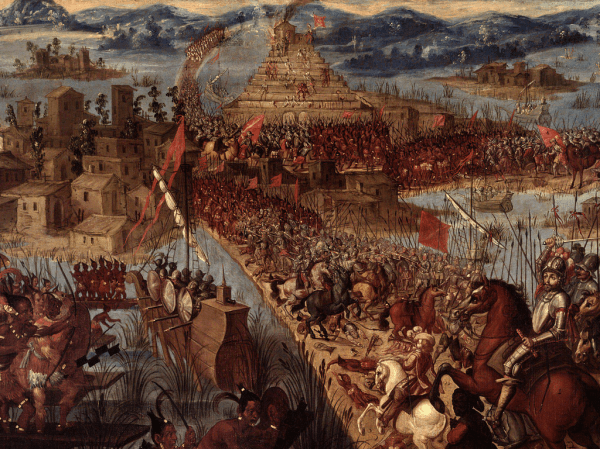
The Spanish conquest of America is a morally complex topic. Like any conquest, it involved brutality and violence. But this is not the whole story: to understand the conquest, one has to understand the logic of the conquerors’ world and their situation. The Spanish, having developed a Christian zeal in the long Reconquista, juxtaposed themselves... Continue Reading →
Polybius and the Background of the Second Punic War’s Outbreak
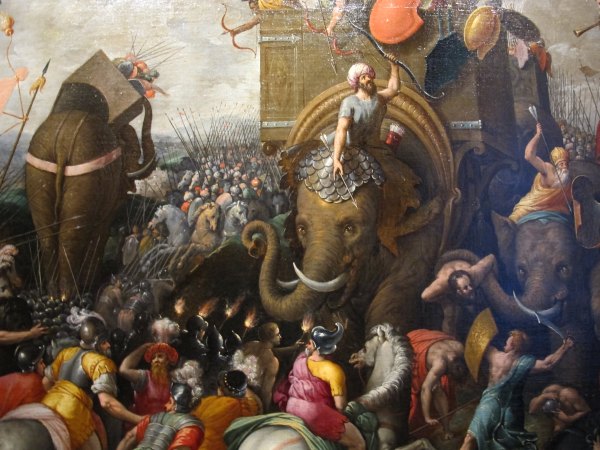
This source is a passage from Book 3, Chapter 30 of Polybius’ Histories on the causes of the Second Punic War. It argues that both sides are to blame for the war, giving reasons why. The Spanish city of Saguntum had placed itself under Roman protection since they had turned to the Romans to solve... Continue Reading →
The Squire’s Tale as a Representation of His Character & Ideals
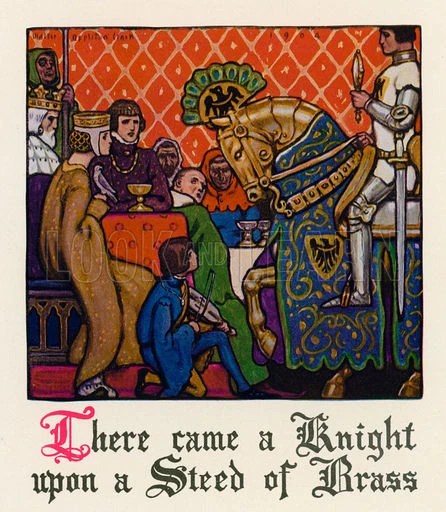
In Geoffrey Chaucer’s The Canterbury Tales, the Squire is one of the characters who gets to tell a tale. His tale is an interlaced romance, a common form in the Middle Ages which was very long. The exotic and fantastical setting of the Squire’s Tale reflects his ambition, talents and imagination, and while he does... Continue Reading →
Criseyde’s Tragic Journey to Love and Back
One of the English poet Geoffrey Chaucer’s most famous poems is Troilus and Criseyde, a retelling of the classic love tragedy poem. It is set amid the background of the Trojan War, but in a 14th century environment. In it, the Trojan prince Troilus falls in love with the Trojan noblewoman Criseyde. Criseyde is a... Continue Reading →
Nietzsche’s Intuition vs De Saussure’s Reason
Friedrich Nietzsche was a German philosopher who pushed back against the narratives of progress and the rationalistic ordering of society in nineteenth century Europe, seeing these along with the societal traditions as hypocritical and repressive. In “On Truth and Lying in a Non-Moral Sense”, Nietzsche strongly critiques the idea of rationality and classification in a... Continue Reading →
The Reader’s Replacement of the Author
The French structuralist writer Roland Barthes wrote a short essay called “The Death of the Author” in 1967. In it, he argues that writing is the destruction of every voice, and that while this has not been recognized before, writers are now starting to take this into account and critics should focus on the reader... Continue Reading →
Plato’s Explanation Of Why Art Is Useless in His State
Plato’s Republic is a Socratic dialogue on justice, how the perfect city-state should be ordered, and how the virtuous man should behave. In “Book X”, Glaucon and Socrates explore the nature of poetry. They argue that Poetry must be excluded from a well-ordered state, as it is an imitative art form, thrice removed from the... Continue Reading →
The American post-WW1 debate between internationalism and nationalism
On January 8, 1918, during World War I which America had just entered nine months earlier, US President Woodrow Wilson outlined his vision of a post-war world in his “Fourteen Points” speech. He advocated for diplomacy, free trade, the creation of an association of nations, and the redrawing of national borders. But Wilson faced backlash... Continue Reading →
John Ponet and Jean Bodin on the nature of political power and sovereignty
In mid-16th century Europe, two intellectual groups, the resistance theorists and counter-revolutionary theorists, reconceptualized the nature of political power. They asked similar questions about the nature of society, government and the right of resistance, but came to very different conclusions. In 1556 the English theorist John Ponet published his Short Treatise on Political Power. Twenty... Continue Reading →
How Martin Luther Reconceptualizes Authority in Two of His Tracts
In 1520, Martin Luther published two tracts central to the Protestant Reformation: To the Christian Nobility in August, and The Freedom of a Christian in November. The former text appealed to the German political authorities to take the initiative in the face of the Church which he saw as corrupt, while the latter has him... Continue Reading →