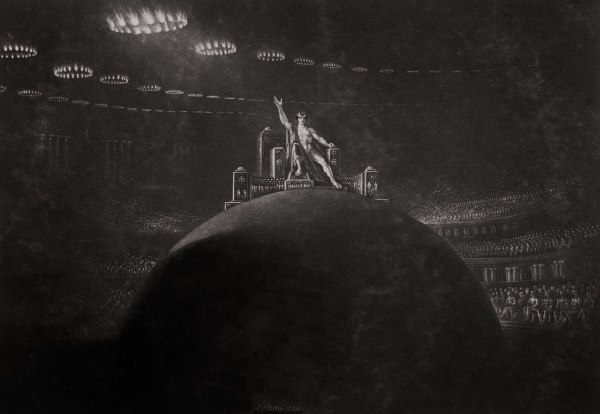
In John Milton’s Paradise Lost, the semblance of hell, Satan and his fellow demons is often radically different from their substance. One strong example of this is in hell’s freedom. Satan claims that hell is a democratic form of government, but this is proven not to be the case through Satan’s tyrannical rule and his... Continue Reading →
Two Versions of King Arthur Contrasted
The story of King Arthur has been told in many different forms over the centuries. Two of the core seminal works are Sir Gawain and the Green Knight, a long poem from the 14th century by an unknown author, and Le Morte d’Arthur, a prose work from the 15th century by Thomas Malory. King Arthur... Continue Reading →
The Spots of the Dreamer in “Pearl”
In Part 16 of the Pearl poem, the Dreamer asks the Pearl-Maiden to show him the way to Jerusalem, but the Pearl-Maiden tells him the difference between the worldly and heavenly Jerusalems. This section is about the spots of man which keep him trapped in the worldly Jerusalem away from the heavenly one, and the... Continue Reading →
The Reconceptualization of Marriage as an Independent Institution in Early Modern Europe
Medieval marriages were multifaceted. In canon law marriage focused more on consent and autonomy than rules. Laws of marriage were not always followed, and different types of marriage could be experimented with. Weddings were often just as much social and opulent events as they were about the couple. Mock youth groups could prepare themselves for... Continue Reading →
John Ponet and Jean Bodin on the nature of political power and sovereignty
In mid-16th century Europe, two intellectual groups, the resistance theorists and counter-revolutionary theorists, reconceptualized the nature of political power. They asked similar questions about the nature of society, government and the right of resistance, but came to very different conclusions. In 1556 the English theorist John Ponet published his Short Treatise on Political Power. Twenty... Continue Reading →
How Martin Luther Reconceptualizes Authority in Two of His Tracts
In 1520, Martin Luther published two tracts central to the Protestant Reformation: To the Christian Nobility in August, and The Freedom of a Christian in November. The former text appealed to the German political authorities to take the initiative in the face of the Church which he saw as corrupt, while the latter has him... Continue Reading →
The Factors Explaining Lutheranism’s Success
One of the most important books on the Reformation is Brand Luther, written by historian Andrew Pettegree. It explores how Martin Luther became the pre-eminent and defining man of his age and how he was able to spread his version of the Christian religion, paying special attention to the role of printing. This paper will... Continue Reading →
The Idle Clockmaker and the Imprisoned Goose
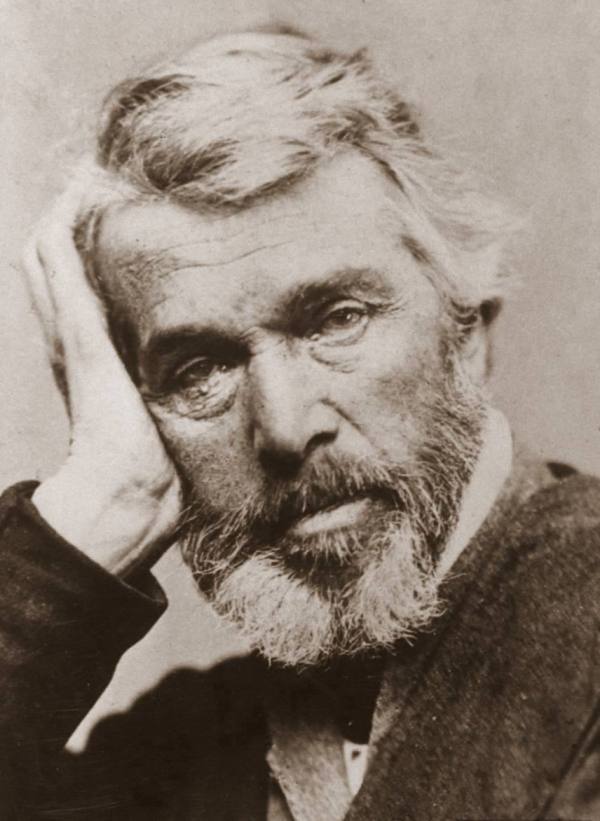
Thomas Carlyle was a Scottish historian and writer who in 1843 published his very influential historical and social criticism book “Past and Present”. There, he joins medieval history with criticism of 19th-century British society. In the chapter “Gospel of Mammonism”, Carlyle examines the materialism of his Victorian society. He argues that a society’s imagery of... Continue Reading →
Close Reading of “The Tyger”
William Blake’s “The Tyger” poem is arguably his most famous work in this form of literature and in all of English. It is about a person who wonders how a tiger is created, but it is not merely a fun poem. “The Tyger” is a discourse on duality, with a speaker who is shocked at... Continue Reading →
The Marvelous Christian Discoveries of St. John Mandeville
The word “marvel/marvelous” conjures up diverse meanings: in the 1300s, it would have meant a marvelous event outside of human power and nature and thus believed to be supernatural/divine. But it can also mean something wonderful or astonishing that causes someone to feel surprise, admiration or wonder (Oxford University Press). Something which is marvelous is all... Continue Reading →