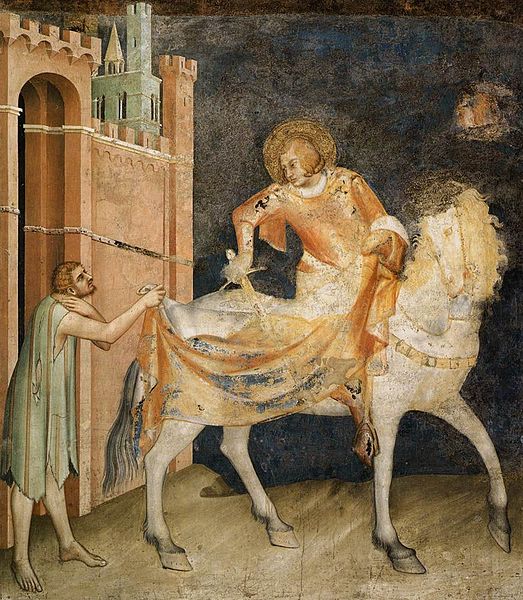
St. Martin of Tours was one of the central saints of the medieval monastic tradition. He had been a soldier, monk, and then bishop of Tours in his lifetime. This essay argues that because Martin was portrayed as the exemplary miles Christi or warrior for Christ in his monastic biography, he was an ideal for... Continue Reading →
Commentary on “The Conversion and Journey of St. Hortensius of Toulouse”
My saint takes inspiration from many of the saints I’ve studied. I decided to choose St. Martin’s time and place for my saint because I found Martin’s life, his time period and his conversion of the pagans interesting. I wanted to create a saint with some similar experiences and qualities while having other ones. Like... Continue Reading →
The Conversion and Journey of St. Hortensius of Toulouse
St. Hortensius was born in Toulouse, southern Gaul, in 334 AD to a wealthy and prominent pagan family. Hortensius always had the light of intelligence, and read the poetry of Virgil, Ovid, and Cicero. Hortensius was full of energy and liked to wrestle. But he was also boisterous and arrogant: as soon as he reached... Continue Reading →
The Spots of the Dreamer in “Pearl”
In Part 16 of the Pearl poem, the Dreamer asks the Pearl-Maiden to show him the way to Jerusalem, but the Pearl-Maiden tells him the difference between the worldly and heavenly Jerusalems. This section is about the spots of man which keep him trapped in the worldly Jerusalem away from the heavenly one, and the... Continue Reading →
The Squire’s Tale as a Representation of His Character & Ideals
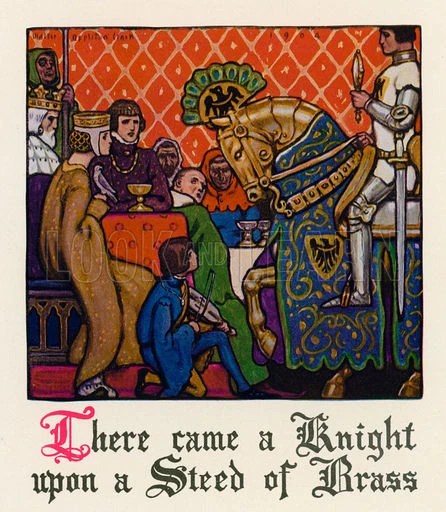
In Geoffrey Chaucer’s The Canterbury Tales, the Squire is one of the characters who gets to tell a tale. His tale is an interlaced romance, a common form in the Middle Ages which was very long. The exotic and fantastical setting of the Squire’s Tale reflects his ambition, talents and imagination, and while he does... Continue Reading →
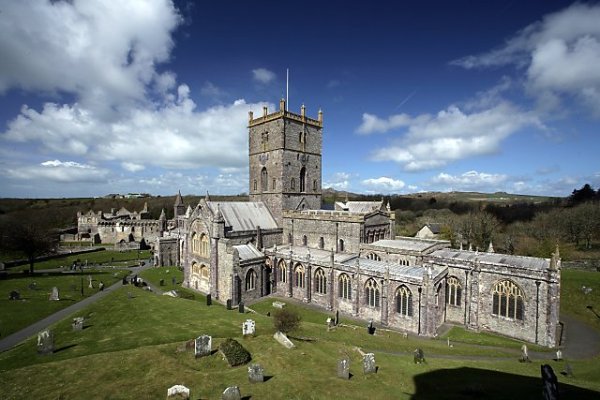
Historical Time Traveler’s Guide: St. David’s and Southwest Wales, late 12th century
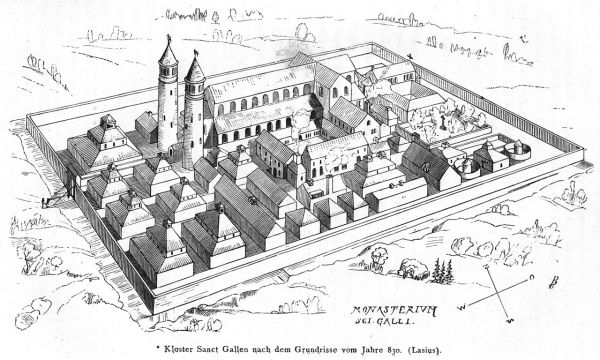
Location St David's is in the region of Deheubarth in the southwest of Wales. It is a remote corner on the coast of the Irish sea, with rocky and barren soil without woods, rivers, or meadows, never exposed to the winds and tempests.[1] The cathedral is in a narrow valley with damp, marshy and unstable... Continue Reading →
“The History of the Kings of Britain” and “Utopia” as Fictional Unifying Narratives
Geoffrey of Monmouth’s The History of the Kings of Britain is a pseudohistorical narrative of the Kings of Britain published in 1136. It begins with the foundation of the British nation by Trojan exiles and continues for about 2000 years until the Anglo-Saxon invasion and the rise of King Arthur. Thomas More’s Utopia is a... Continue Reading →
Medieval Ireland Tourist Brochure
This brochure promoting tourism to Ireland is based on “The History and Topography of Ireland” by Gerald of Wales. What defined the work for me was Gerald of Wales outlining the benefits of Ireland’s natural features such as the climate and the air. I also liked how he praised the music of the native Irish... Continue Reading →
The Marvelous Christian Discoveries of St. John Mandeville
The word “marvel/marvelous” conjures up diverse meanings: in the 1300s, it would have meant a marvelous event outside of human power and nature and thus believed to be supernatural/divine. But it can also mean something wonderful or astonishing that causes someone to feel surprise, admiration or wonder (Oxford University Press). Something which is marvelous is all... Continue Reading →
Waking Up
The darkness parted away like a curtain, revealing a long wooden room, filled with tables and chairs. The image flickered and took a while to form. I had just woken up and could not remember where I was or what I was doing there. However, the glass bottles beside me on the round table indicated... Continue Reading →