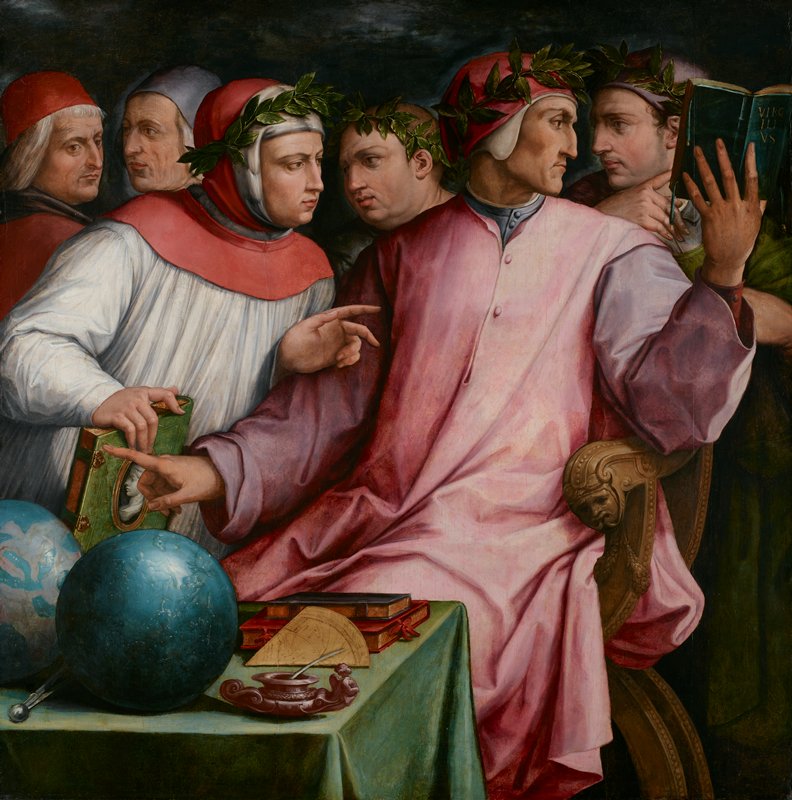
Dante Alighieri and Francesco Petrarch were Florentine thinkers active in the 13th and 14th centuries. But their worldviews were very different, and two of their most famous texts reflect this. Dante’s On Monarchy uses Aristotelian scholasticism to argue that the Holy Roman Emperor has the right to rule over Europe. Meanwhile, Petrarch’s On His Own Ignorance is a response to his Scholastic detractors and a manifesto of Renaissance humanism. This essay argues that Dante is making a formulaic argument citing sources anachronistically and uncritically to show that he knows the truth, while Petrarch contextualizes his sources and writes eloquently to argue that the truth cannot be known outside of Christianity and that it is more important to persuade people to do the good.
Dante argues for one Truth. Dante defines temporal monarchy as “a single sovereign authority set over all others in time” (Dante 4). Dante will draw the truth “forth from where it lies hidden” (Dante 4). He is assuming that it is a universal truth that temporal monarchy, or the Holy Roman Emperor, is the proper authority to rule over all of Europe. The scholastic view is that there is one objective Truth for all times and places, and that it can only be apprehended through the correct method. Dante argues from first principles: he is searching for “the purpose of human society as a whole” (Dante 5). Dante believes “nature ordained a place and a nation to exercise universal rule in the world” (Dante 47). Dante assumes that nature is an objective category of analysis that can be used to explain subjective human behaviour, and that actions are simply part of the world’s natural order. He ignores human agency and will. Scholastics were more concerned with metaphysics and the divine than the human form. The medieval view of life was that it was a burden and that its only purpose was to be endured so the soul could move on to heaven. In this vein the human form was seen as irreparably flawed and sinful. That is why Dante’s scholastic philosophy largely overlooked the human experience to find one Truth.
Petrarch is sharply critical of this formula: he berates scholastics for asking dumb questions like “how many hairs there are in the lion’s mane” (Petrarch 57). To Petrarch the grammatical technicality of Scholasticism has no substance behind it, and it has ridiculous propositions. Petrarch questions the point of knowing animal or metaphysical nature while “neglecting man’s nature, the purpose for which we are born, and whence and whereto we travel” (Petrarch 58-59). Petrarch thinks that knowledge is only useful for understanding humanity and how to live an ethical life. The Renaissance celebrated humanity: artists like Da Vinci and Michelangelo tried to accurately depict the human form down to the minutest detail. Da Vinci and other Renaissance intellectuals like Vesalius literally dissected human bodies to understand how they work. Renaissance humanism was concerned with “moral philosophy (ethics) at the expense of theology and scholastic reasoning” (Bartlett 69). In contrast, the humanists virtually ignored metaphysical and natural philosophy, along with science (Bartlett 84). Petrarch and the humanists “accept in humble faith the secrets of nature and the mysteries of God, which are higher still; they [Scholastics] attempt to seize them in haughty arrogance” (Petrarch 76). Petrarch berates the Scholastics as unfaithful for their urge to know what only God can instead of being satisfied with Christianity’s truths. Petrarch recommends Cicero, Seneca and Horace to teach moral philosophy (Petrarch 103-4). So Petrarch believes people should pursue virtue rather than Truth.
Dante uses his sources anachronistically and uncritically to justify his arguments. His second argument explores whether “the Roman people [took] on the office of monarch by right” (Dante 4). He sees the Holy Roman Empire as a continuation of the ancient Roman Empire, ignoring their different contexts. The scholastics saw no break between their own era and the classical one, so they depicted classical figures in a medieval context: like Virgil as a scribe. Dante cites Aristotle’s point in his Politics that “certain peoples are born fitted to rule, and certain others to be ruled and serve” (Dante 47). Dante is using Aristotle to understand social and political relationships in the Roman Empire, despite the fact that Aristotle was a Greek in the 4th century BC. Dante is not analyzing or criticizing his sources and is assuming that Aristotle’s truths held for all times and places. When arguing against the Donation of Constantine, Dante cites a point in Aristotle’s Ethics that “a person who gives functions as an agent, and a person who receives as a patient” (Dante 83). He also cites the Book of Matthew in the New Testament: “Provide neither gold, nor silver, nor brass in your purses, nor scrip for your journey” (Dante 83). Dante is pairing two exterior sources to make a moral, legal argument against the Donation. Lorenzo Valla will later look at the Donation’s language to prove it’s fake. Dante is using these sources outside their contexts.
In contrast, Petrarch analyzes his sources and takes historical context into account. Petrarch wonders how “Aristotle could have known something for which there is no reason and which cannot be proven by experience” (Petrarch 74). Petrarch is sharply critical of Aristotle for making assertions without proof. Renaissance humanists were willing to criticize and pick apart respected sources. They found many original ancient texts, which they “dissected and studied to reveal truths not known before” (Bartlett 66). Petrarch says of the pagans that while they “may tell many fables about their gods, they do not, at any rate, blaspheme; they have no notion of the true God” (Petrarch 79). Petrarch accepts the paganism of the ancients while learning from them. Petrarch quotes Cicero positing the idea that whatever is perceived “is made by God for the well-being of man and governed by divine providence and counsel” (Petrarch 86). Despite being a pagan Cicero had some ideas in line with Christianity, so they reinforce his importance as a moral philosopher for Petrarch. Petrarch also quotes the Apostle Paul: “There must be heresies that they which are approved may be made manifesto to you” (Petrarch 115). The Apostles were intensely engaged with classical Greco-Roman ideas and even spoke Greek. Petrarch is using the Apostle’s words to prove that reading pagan ideas actually enriches his Christian faith. So Petrarch engages with his sources.
Dante’s argumentation is syllogistic and logical. Dante’s second argument is that “the Roman people subjecting the world to its rule did this in accordance with right” (Dante 44). Dante is making a moral argument that the Romans embarked on their conquests to benefit their community, so it must logically follow that they were justified in doing so and the contemporary HRE must rule Europe. One of Dante’s arguments against the Donation of Constantine is that “to divide the empire is in conflict with the office bestowed on the emperor” (Dante 81). To Dante an entity or form cannot act against its nature by diminishing itself, as the emperor’s responsibility is to keep the empire united or expand it. Dante argues that “the empire had all its authority at a time when the church did not exist or had no influence” (Dante 87). Dante is making an appeal to age: the Roman Empire’s older age justifies the contemporary HRE’s authority over Europe. All these points are self-evident in his view, so they do not have to be proven through persuasion. But Dante’s syllogistic argumentation doesn’t work for a loaded political situation like the Ghibelline-Guelph dispute, because people are emotional and can often only be persuaded by crafty, eloquent arguments. Dante’s writing is dull and lacks emotion: he never refers to himself in the first person except in the beginning of his book.
Petrarch’s writing, on the other hand, is infused with eloquence. Petrarch criticizes Aristotle for “lacking the words that sting and set afire and urge toward love of virtue and hatred of vice” (Petrarch 103). In contrast, that eloquence can be found in Cicero, Seneca and Horace, because they are trying to move their readers. For Petrarch, “good letters, good style, and good speech are social virtues” (Bartlett 63). Beauty is truth, and only eloquence can persuade people to pursue the good. This is the entire purpose for the humanist resurrection of classical values. This is a major difference between Renaissance and medieval writing and art: Renaissance art is meant to awe the viewer, so it is filled with detail and beauty. People who look at a piece of art like Michelangelo’s Pieta are struck by it’s detail and the emotion on Mary’s face. Medieval depictions of Mary and Jesus are plainer and do not evoke the same level of emotion. Petrarch says that “I cannot, I confess, lift up, however ardently I should wish, the inferior parts of my soul, in which the irascible and concupiscible appetites are located” (Petrarch 113). This is just one example of how Petrarch’s writing is infused with emotion, and he constantly refers to himself and his individuality. The Renaissance was concerned with the individual. Renaissance artists signed their art with their names, unlike medieval artists. So Petrarch believes you have to persuade people to be virtuous through eloquence.
In conclusion, Dante and Petrarch’s works reveal the differences between the medieval Scholastic and Renaissance humanist worldviews. Dante uses logical scholastic syllogisms and cites his sources uncritically to argue one Truth, while Petrarch analyzes his sources and writes eloquently to argue that rather than pursuing one Truth outside religion, people should concern themselves with pursuing virtue. Petrarch was an early humanist, so he did not embody all the Renaissance’s characteristics. He was a scholar living the contemplative life removed from politics. Later in the Renaissance the active life and putting humanism to use in politics became a core principle. But Petrarch was the foundation of the Renaissance, and his ideas were built upon and further developed.
 diegodelaparra
Leave a comment