Mycenaean Greece was the late Bronze Age period of Greek history from around 1750 to 1050 BC, when the first advanced civilization emerged in mainland Greece. It is named after the city of Mycenae. The Mycenaean Greeks made significant advances in engineering, architecture, and military infrastructure. They created the first Greek script, Linear B, and worshipped the Olympic deities.
Mycenaean civilization began around 1750 BC, when seats of power dominated by warrior elites emerged in southern mainland Greece. Many cities built walls and proto-palaces. This period is called the Shaft Grave era after its most common type of burial. Mycenaean elite men were often buried with golden masks and funerary armor, and women with golden crowns and ornaments. The Mycenaean states interacted with the whole Eastern Mediterranean. They were influenced by the Minoans, and had simpler but more monumental craftsmanship and architecture which later outshined its counterparts. At the end of this period, the tholos grave type emerged, with big, circular chambers, high vaulted ceilings and a stone-lined entry hallway. The Treasury of Atreus is the most famous tholos, and uses the relieving triangle, a Mycenaean innovation.
In the Koine era, beginning in the 15th century BC, the Mycenaeans extended their soft power, becoming the Eastern Mediterranean hegemon. They took power in Knossos, adding a throne room to its palace with the earliest Linear B writings. The Mycenaean trade network reached Spain & Jordan. Mycenaean Greeks bought raw items like metals, glass, and ivory, creating goods from them which they exported with local products like olive oil, pottery, wine, wool, and perfume. Miletus became Anatolia’s Mycenaean center.
The Mycenaeans created remarkable metalwork, including the Mask of Agammemnon, the Silver Siege Rhyton, the Bulls-head Rhyton, and Nestor’s Cup. They also produced drinking vessels like stirrup jars, bowls, alabastra, kraters, and kylix cups. These vessels often had painted shells, octopuses, flowers, or Iliadic scenes. Mycenaean sculptures have not been found, but small figurines have, of which most are female and anthropomorphic or zoomorphic. There are three types: the Psi, Phi, and Tau. They were likely both toys and votive objects.
Imposing palaces were built in mainland Greece as seats of government for the different states, with Sparta’s Menelaion being an early example. Other palaces were located in Midea and Pylos in the Peloponnese, Athens, Eleusis, Thebes, and Orchomenos in Central Greece, and Iolcos in Thessaly. The megaron or throne room was the palace’s central feature, with four columns surrounding a central hearth and the throne typically on the right. The palaces were decorated with fresco paintings of sea creatures, hunts, bull-leaping, processions, battles, or mythological scenes. Mycenae and nearby Tiryns built fortifications in a Cyclopean style, with large, unworked boulders. The palatial system was bureaucratic, with stratified, specialized offices headed by the king or wanax. Below the aristocracy was the people or damo, with slaves at the bottom. A confederation of states led by Thebes or Mycenae probably existed.
The Mycenaeans had advanced warfare practices. Mycenaean warriors commonly wore boar tusk helmets and armor similar to the Dendra panoply. Early Mycenaean armies were made up of heavy infantry, arrayed with spears, big shields, and sometimes armor. Later, weapons became lighter. Chariots were likely used for fighting before being limited to transport.
The Mycenaeans heavily intervened in Anatolia as proven by Hittite records, which call their land Ahhiyawa. Around 1400 BC, an Ahhiyawan warlord, Attarsiya (likely Atreus) attacked Hittite vassals like Madduwatta. Later around 1315 BC, Ahhiyawa aided an anti-Hittite rebellion led by the vassal state of Arzawa. During the Hittite king Hattusili II’s rule from about 1267 to 1237 BC, Ahhiyawa supported Piyama-Radu’s rebellion, causing turmoil which probably reached Wilusa, the region of Troy. Scholars believe that the Trojan myths come from this period’s events. The Hittite & Mycenaean kings negotiated peace, with the Hittite records mentioning Tawagalawa (perhaps Eteocles) as the latter king’s brother.
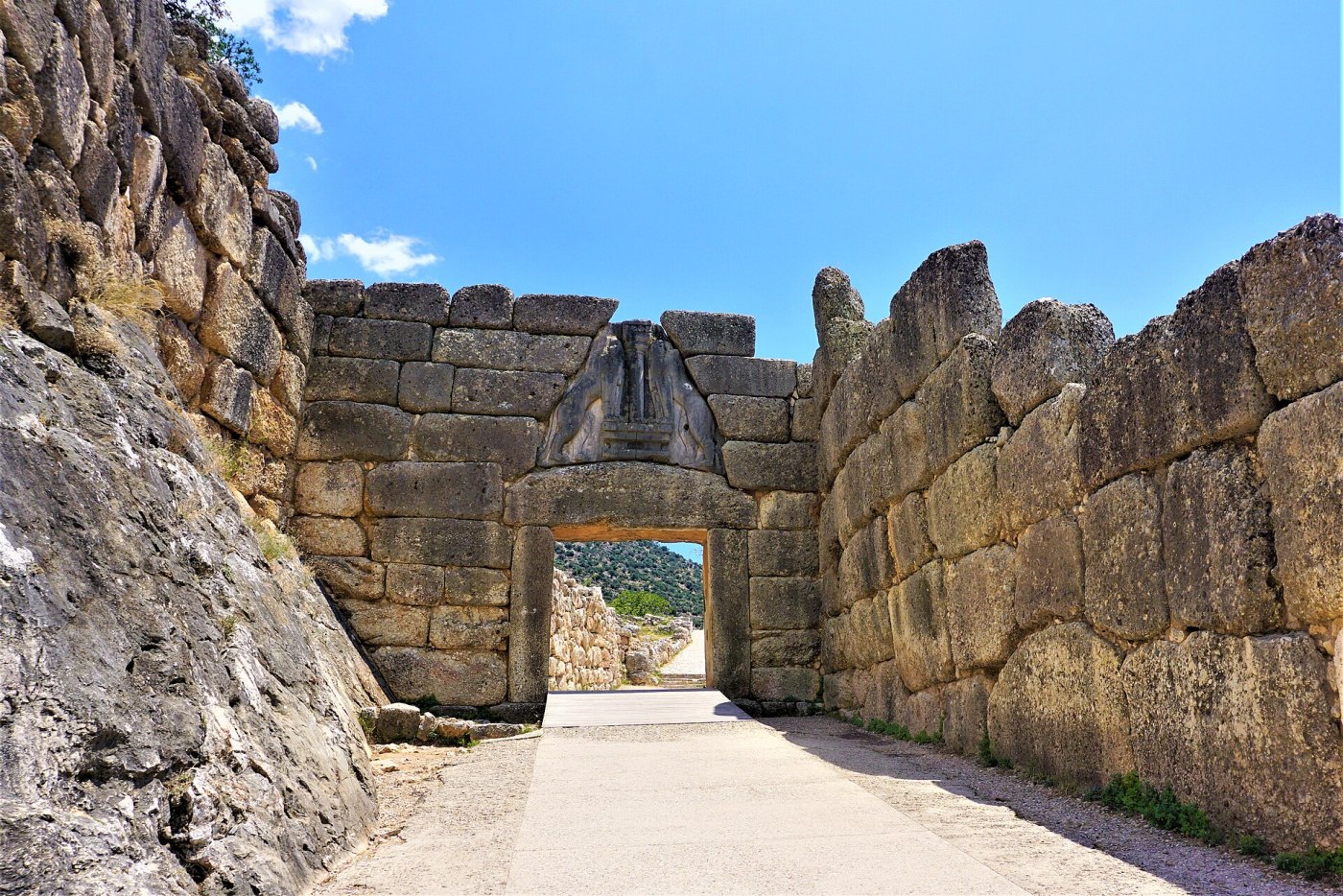
Mycenaean civilization’s decline began around 1250 BC, when Thebes and much of Mycenae were burned down. In response, Tiryns, Midea, and Athens built new Cyclopean walls. Mycenae extended its citadel’s fortifications and built the Lion Gate. Eastern Mediterranean trade declined. Mycenae was destroyed again with the palaces at Tiryns and Midea in 1190 BC. Pylos followed around 1180 BC. This chaos caused Greece’s population to decline, beginning the Greek Dark Ages. The accepted theories for the Mycenaean collapse are population displacement, climate change, overpopulation-induced migration and internal strife including the Dorian conquest and the Sea Peoples’ actions.
Classical Greeks idealized the Mycenaean period as a heroic age, when myths and legends like the Trojan Epic Cycle were believed to have occurred. German archaeologist Heinrich Schliemann proved the relative historicity of the legends through his excavations of Mycenae and discovery of Troy at Hisarlik. Mycenaean infrastructure was unparalleled until the Roman period.
 diegodelaparra
Leave a comment