The pre-Socratics were the first philosophers in the West and possibly the world, living in the 500s – early 400s BC. They asked questions about the world and tried to answer them by applying human reason, knowledge, and science rather than mere myth. While some of their answers were wrong, the nature of their discourse was significant. Many pre-Socratic philosophical schools created original ideas that subsequent philosophers like Plato and Aristotle built on or responded to.
The name of the pre-Socratics is a bit misleading, as Socrates was active in their later period. Greek mythology provided a foundation for pre-Socratic philosophy. Both made guesses about an invisible universe sustaining the visible one. However, the pre-Socratics sought to explain the world in natural scientific terms instead of telling mythological stories about anthropomorphic gods. They also sought the one principle that sustained the cosmos, rather than mythology’s multiple explanations. Pre-Socratic philosophers were equivalent to natural scientists as the distinction between ethical philosophy and science didn’t exist yet. They did not believe in any separation between the natural and supernatural either. The pre-Socratic belief in a naturally ordered universe with a fundamental unity was their most important contribution.
The earliest pre-Socratic philosophers came from Miletus in Ionia, and they were likely interested in the physical world because as pioneers in the land, they had to speculate about the nature of things. Their main focus was the universe’s basic substance. Thales of Miletus, the first pre-Socratic philosopher, posited that it is water, and that the Earth is a discus floating on it. He was probably inspired by the universal need of every living being to have water. He also noticed how water goes through the three stages of matter: while it is a liquid, it can turn into a gas vapor and solid ice. Thales speculated that water can become earth if made solid, and fire if turned into gas. Water was one of the main four Greek elements: the others being earth, fire, and air. Thales was significant as he looked for natural rather than supernatural causes of things, believing that humans must use their reason to try to find answers and only consider supernatural explanations if that fails. He famously said “all things are full of gods”, setting the Pre-Socratic trend of seeing the natural & supernatural worlds as one. The nature of his questions was important: he explored the source of the universe and the process of its creation, rather than who made it and why. He also looked past his sensory perceptions, believing they were not enough and had to be augmented with reason to discover the world’s fundamental substance. Thales apparently fell in a well while lost in reflection. He was also said to be a sharp businessman who bought all the wine presses when he anticipated a good olive harvest. According to Herodotus, Thales successfully predicted a solar eclipse in 585 BC, convincing the belligerent Medes and Lydians to make peace. Without Thales’ idea of a prime matter outside of divinity, the science of meteorology could have degenerated into divination and fortune telling. Other Ionian philosophers came up with their own theories: Anaximenes proposed air as the universe’s primary element, while Anaximander posited an infinite, invincible matter, and wondered how Thales could think water could be the source of the fire that quenches it. He also wrote geographical information about the size and locations of several countries and their distances on the map. The Ionian breakthrough of rational speculation was foundational to Western philosophy.
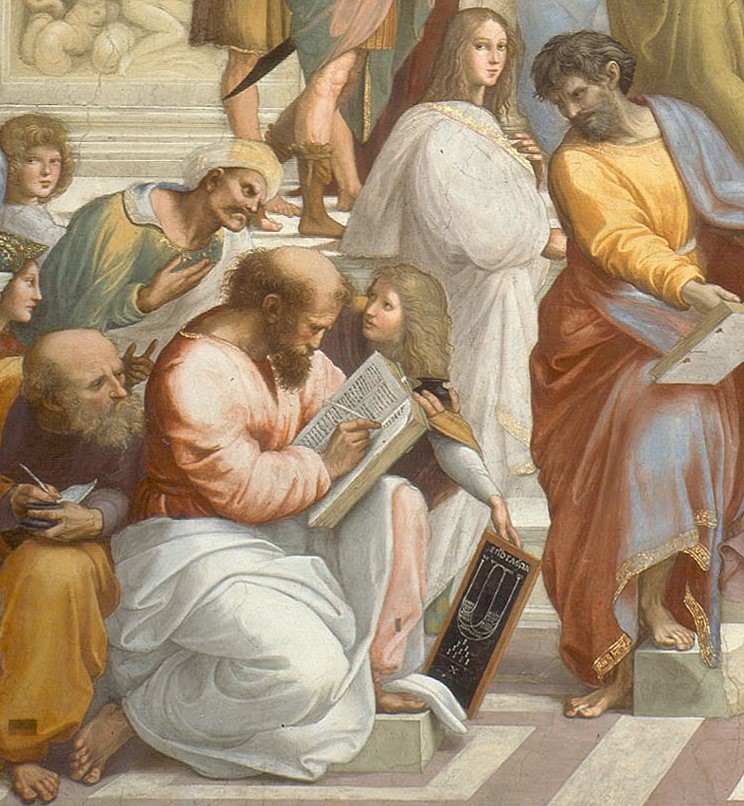
A unique pre-Socratic school was the Pythagoreans, led by Pythagoras, a brilliant mathematician and moral philosopher born in Samos and raised in southern Italy. He is associated with the Pythagorean theorem of a right triangle, but there is no direct evidence he invented it. However, he did theorize that numbers are the fundamental element, as he was inspired by patterns and mathematical consistency in orbits, seasons, and other changes in the natural world. He noted musical harmony as a mathematical feature: for instance, if one yanks a string, cuts it in half, and yanks it again, it now sounds an octave higher. Pythagoras and his followers saw math as quasi-divine since it provides absolute truths, anticipating modern science’s search for mathematical rules. However, Pythagoras’ main contribution was a moral way of life, an exception to the Socratics’ general lack of interest in morality. He required his followers to commit to austere dress, celibacy and special dietary rules. Pythagoras kept much of his doctrine secret, but it is known he believed harmony comes from virtue, attained through a balance of the faculties. The lower parts of man’s nature, meaning the base instincts, appetites and passions shared with animals, have to be ruled by the higher nature, which is reason. This higher nature is realized through learning, abstinence, music, and exercise. This reflected the ancient Greek celebration of the human form and pursuit of its perfection. Pythagorean thinking was elitist, leading to the school’s persecution and fall, although the neo-Pythagoreans later emerged in the 1st centuries AD from the rise of Christianity and mixing of different philosophical schools in the Roman Empire. Pythagorean humanism was important for the development of Greco-Roman civilization.
The Eleatics were another pre-Socratic philosophical school, named after the city of Elea in southern Italy. They focused on the current world rather than its origins. Xenophanes, the first Eleatic, proposed earth as the primary element within a spherical universe. He denounced poetic portrayals of the gods as immoral beings enslaved by their passions who manipulated humans for their benefit, arguing that divine beings are morally perfect. He built on the poet Hesiod’s argument for the gods’ morality. Xenophanes famously said: “each man represents the gods as he himself is: the negro as black and flat-nosed, the Thracian as red-haired and blue eyed, and if horses or oxen could paint, they no doubt would depict the gods as horses and oxen”. His point was that everyone depicts the gods anthropomorphically, but they are above humans. While he argued for one god, it is unknown whether Xenophanes was a polytheist or monotheist: he likely conceived of one supreme god ruling over lower deities. Xenophanes set a trend of ethical monotheism in Greek philosophy, contributing to the creation of Christianity. Parmenides, another Eleatic philosopher and likely contemporary of the young Socrates, taught that nothing changes and everything is permanent. His justification was that Being is eternal and preceded itself, since it cannot arise from a non-existent not-Being. To him, whenever something changes, it turns from Being to not-Being. Ex: if you go outside and feel heat, you go from not-hot to hot, or if you grow tall, you go from not-tall to tall. Parmenides distrusted both common opinion and the senses. Zeno also tried to refute change: giving a journey from A to B as an example. There are infinite points between them, but one cannot traverse infinity, making change impossible. An arrow flying through the air always rests in one place, so it is still and not moving. Aristotle cited Zeno’s argument against motion, which is all we have of his ideas. Plato and Aristotle replied to Parmenides and Zeno, with the latter arguing that change is possible: for example, one has the potential to feel heat, and the Sun can make that happen. You are stable, but potential can change you. Parmenides characterized Eleatic discourse on the nature of being.
Later Ionian philosophers continued to speculate about the world’s primary element, but also engaged in their own discourse about the state of the current world, often responding to Eleatics. Heraclitus argued the opposite of Parmenides: that nothing is permanent and the world is always changing. He famously said that “one cannot step in the same river twice”. From life to death, youth to old age, sleep to wakefulness, there is constant change. Everything becomes its opposite before reverting to its original nature. Heraclitus also taught that the world is subject to a rational law, logos. Plato and Aristotle attempted to synthesize Parmenides’ and Heraclitus’ perspectives, showing how later Greek philosophers built on and often synthesized the ideas of their predecessors. Empedocles declared that everything in the world is made up of water, earth, air, and fire, with heaven sometimes added as a fifth element. Physical things are created by the mixture and division of these elements. Anaxagoras believed that the universe was ruled by nous, or “mind”. Considered the father of meteorology, he found that the moon’s light reflects from the sun, causing eclipses. He believed that the point of life was to uncover the secrets of the sun, moon, and stars. However, Athenians considered it blasphemous to analyze the sky, with their leader Pericles infamously outlawing it. Anaxagoras’ rival, Cleon, called him a blasphemer for saying the sun was just a giant burning stone. Anaxagoras was prosecuted for impiety and fled to the Hellespont. Aristotle noted that Anaxagoras always looked for natural explanations for things, rather than deferring to myths. In one instance, Pericles was brought a ram with just one horn on it, seen as a bad omen. But Anaxagoras opened and examined the animal’s skull, discovering that abnormal brain growth caused this weird phenomenon. Anaxagoras emphasis on observation as proof made him the first empiricist.
The Atomists were another school whose luminaries included Democritus and Leucippus. They were materialistic, teaching that all matter, even the mind and soul, is made up of invincible atoms. This was an important scientific breakthrough, but they also saw the senses as deceptive: to them, one may feel bouncing atoms, but they might be untrustworthy. Therefore, reason cannot be trusted and the absolute truth cannot be found. This paved the way for Sophism. This school, present in 5th century Athens, had a philosophy of moral relativism. In Protagoras’ words: “Man is the measure of all things”. They believed moral absolutes don’t exist, so all laws are arbitrary and can be discarded with, allowing people to do whatever is in their interests. Sophists taught rhetoric and persuasive speech, crucial skills in Athens for addressing the assembly or defending oneself in court. However, they taught how to persuade people to believe anything, even if it is a lie. Socrates feared that this would morally poison Athenian youth and dissolve the city-state’s traditional values, so he vehemently spoke out against Sophism. He said that some laws are moral and crucial, like prohibitions against murder. Sophists likely conceded that banning murder is necessary, but argued that it isn’t a moral necessity, instead a practical one to avoid societal collapse. Socrates’ counter-argument was that the law is simply an extension of absolute universal Justice that pre-existed humanity. Through this, Socrates kept Greek philosophy grounded in absolute moral truths and prevented it from degrading into selfish moral relativism. Atomism’s scientific contributions were kept, but its questionable moral successor of Sophism was rejected.
The pre-Socratics used their reason to search for the governing principle and primary element of the universe. Not all of these philosophers were correct as they often contradicted each other, and they also did not separate the natural sciences from philosophical and moral speculation. However, they paved the way for Socrates and his successors. Aristotle started the separation between science and philosophy, with a successor of his, Strato of Lampsacus, completing the separation through his pivot of the Lyceum from logic to experiment.
 diegodelaparra
Leave a comment