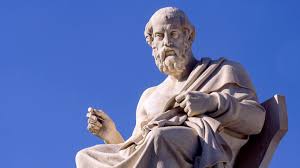
In Plato’s Republic, Socrates discusses the philosopher king, ruler of his ideal city state of Kallipolis. He is the best suited to protect the state’s laws and institutions, hence his other name of the guardian. The philosopher king is wise, austere, and just. He learns the true Forms and how to implement them in his state. He is temperate, seeking knowledge above bodily pleasures and balancing his soul. Finally, he is just, aiming for the good of his subjects as the goal of his rule.
The philosopher king loves learning and sees the true, eternal nature of everything. He looks at the immaterial world of the Forms, beyond this material world. There, he discovers the true Forms of beauty, goodness, and justice, so that he can implement them in his world. He knows the truth, while others only have opinions. While other’s memories are fleeting, the philosopher king has a good memory, so he retains everything he learns. As the Allegory of the Cave discusses, most people are stuck in the material world and fail to grasp the immaterial Forms. Plato did not believe in democracy because of the fleeting nature of the masses, and thought that the philosopher king should rule autocratically. But it is not enough for the philosopher king to just find the Forms: he must understand how they connect in one clear structure. Therefore, both memory and astuteness are important for the philosopher king. He learns how to justly govern the city-state by benefitting its different parts and therefore the whole, while making its architecture and infrastructure beautiful. The philosopher king is wise and never believes lies. It is important for him to combine intelligence and wisdom: one can have great intelligence but lack the wisdom to exercise it properly, and that can be disastrous. A smart but short-sighted philosopher king can fail to see threats to his city-state which could lead to his downfall. The philosopher king learns the Forms, and understands how to implement their insights in his state.
The philosopher king is austere, focusing on his soul rather than being distracted by bodily, material pleasures which will corrupt him. He elevates the rational part of his soul over the spirited and appetitive ones. Everyone’s appetite must be satisfied, and the philosopher king is no exception. However, he only takes his necessary bodily needs without overindulging. Thus, he exercises temperance, uniting the spirited and appetitive parts of his soul under the overlordship of his reason. The philosopher king’s abstinence is extreme: he avoids certain theatrical plays that could inspire evil, and Homer because his work depicts the gods as morally flawed and is thus a bad model to follow. The philosopher king cannot even have a family, as he may unfairly advantage them through nepotism, or private property, as it tempts him towards corrupt self-enrichment. Rather, the philosopher king treats all his subjects like his family, and in return they provide him with necessities. Abstinence strengthens the philosopher king’s spirit, or courage, which is important to maintain the rational part’s decisions against any pain and suffering it might cause him. He is not a coward, but is willing to die for his beliefs. The philosopher king must have a harmonious disposition, with all three parts of his soul balanced. This reflects the justice of his city-state, where all three classes, the artisans, auxiliaries, and guardians, work together while staying in their lanes. These classes are analogous to the divisions of the soul. The philosopher king’s temperance keeps his focus on the good of his city-state.
The philosopher king’s power comes with the responsibility to govern justly. Socrates discusses the definition of justice in an earlier book of the Republic. Cephalus says that justice is giving people what belongs to them, and Socrates replies that it is wrong to give something back to someone if they cause trouble with it. The philosopher king is pragmatic rather than legalistic, prepared to even break rules if following them is unjust. For example, parents are the legal guardians of their children, but if a child abused by his parents runs away, it would not be just to return him to them. Polemarchus suggests that justice is helping one’s friends and hurting one’s enemies, but Socrates replies that any harm, even to enemies, is unjust. Thus, the philosopher king avoids letting resentment or partisanship cloud his judgement. Thrasymachus argues that justice is whatever benefits the stronger person, and that he can even do bad things if they benefit him. Socrates’ response is that just as the craftsman works hard to make his object good, the philosopher king rules for others and not himself. He is reluctant to even rule but does so because he fears being ruled by someone less moral or capable. Even if the philosopher king can benefit by doing something immoral, he does not do it. It is especially then that he proves his value: it is easy to do what is right when it benefits you, but when it doesn’t, that is when the fear or temptation not to do it sets in. The philosopher king dedicates his life to his subjects.
The philosopher king of Plato’s Kallipolis is the city-state’s best of men. He is wise, temperate, and just. The philosopher king discovers the true Forms in the immaterial world and implements them on his own. He avoids material pleasures and elevates his mind, balancing his soul. Finally, he works to achieve justice for his subjects. Plato’s Republic has been considered the greatest work of philosophy ever written, with its political model inspiring many Western and world leaders. Alexander the Great, Marcus Aurelius, Matthias Corvinus, Frederick the Great, and Thomas Jefferson are among the rulers who have been considered philosopher kings.
 diegodelaparra
Leave a comment