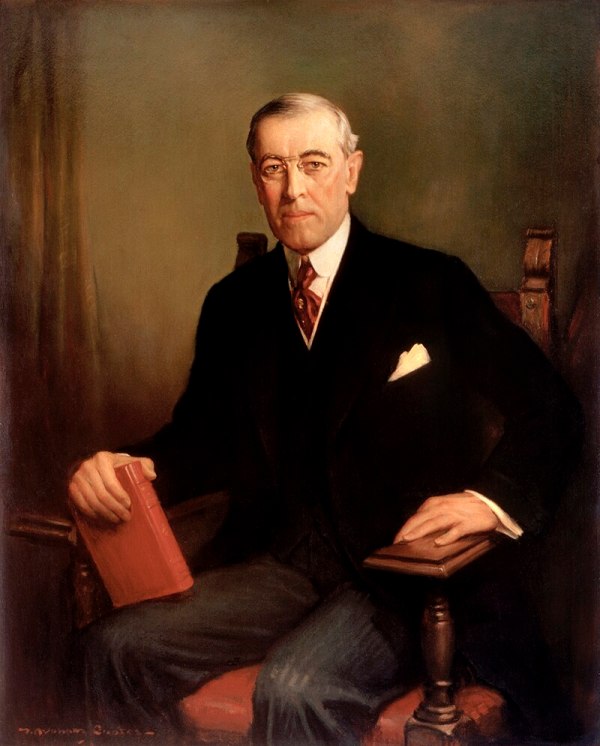
On January 8, 1918, during World War I which America had just entered nine months earlier, US President Woodrow Wilson outlined his vision of a post-war world in his “Fourteen Points” speech. He advocated for diplomacy, free trade, the creation of an association of nations, and the redrawing of national borders. But Wilson faced backlash... Continue Reading →
John Ponet and Jean Bodin on the nature of political power and sovereignty
In mid-16th century Europe, two intellectual groups, the resistance theorists and counter-revolutionary theorists, reconceptualized the nature of political power. They asked similar questions about the nature of society, government and the right of resistance, but came to very different conclusions. In 1556 the English theorist John Ponet published his Short Treatise on Political Power. Twenty... Continue Reading →
How Martin Luther Reconceptualizes Authority in Two of His Tracts
In 1520, Martin Luther published two tracts central to the Protestant Reformation: To the Christian Nobility in August, and The Freedom of a Christian in November. The former text appealed to the German political authorities to take the initiative in the face of the Church which he saw as corrupt, while the latter has him... Continue Reading →
The Factors Explaining Lutheranism’s Success
One of the most important books on the Reformation is Brand Luther, written by historian Andrew Pettegree. It explores how Martin Luther became the pre-eminent and defining man of his age and how he was able to spread his version of the Christian religion, paying special attention to the role of printing. This paper will... Continue Reading →
The Trap of Multiculturalism in “Squatter” and “Simple Recipes”
“Squatter” is a short story by Indo-Canadian writer Rohinton Mistry about a man named Sarosh who immigrates to Canada from India but leaves a decade later after failing to use the toilet properly in his new country. “Simple Recipes” is another short story by the Chinese-Malaysian Canadian writer Madeleine Thien about a Chinese Canadian family... Continue Reading →
Marilla’s Journey of Letting Go
Anne of Green Gables is a 1908 novel written by Lucy Maud Montgomery which explores the coming of age of a girl named Anne Shirley in the town of Avonlea. While Anne’s imaginary adventures make the book resonate with children, it is Marilla’s struggles that adults identify with. In the beginning of the novel Marilla... Continue Reading →
A Counter Narrative to “The Indian Girl in Modern Fiction”
In her 1892 article “A Strong Race Opinion: On the Indian Girl in Modern Fiction” the Canadian First Nations author Pauline Johnson critiques the narrow, stereotyped representation of Indigenous women in fiction. She wrote a counter narrative in her short story “A Red Girl’s Reasoning”. In mainstream Amerindian stories written by white Canadians at the... Continue Reading →
The Kilt God is Cast Down
Wilfried Owen’s poem “Disabled” follows a soldier who has lost his legs during the war and is now alone and isolated. The poem uses images of color and temperature to show how the soldier changed before and after the war. The many colors and heat represent his innocence and vivacity, but after joining the military... Continue Reading →
The Mocking Romanticization of the Doomed Cattle
Wilfried Owen wrote many poems in the First World War, with one of the most famous being “Anthem for Doomed Youth”. Written in 1917 when he was recovering from injuries in the hospital, it depicts the dark destiny of young men fighting in the war to die. It is a warning against romanticizing the war,... Continue Reading →
Jekyll’s Fatal Voyage of Transcendence
Robert Louis Stevenson was a Scottish novelist, poet and travel writer who published a novella called The Strange Case of Henry and Jekyll in 1886. It is about a doctor called Henry Jekyll who separates himself into two beings. Through his investigations of the human psyche, Jekyll discovers that he is not simply one being,... Continue Reading →