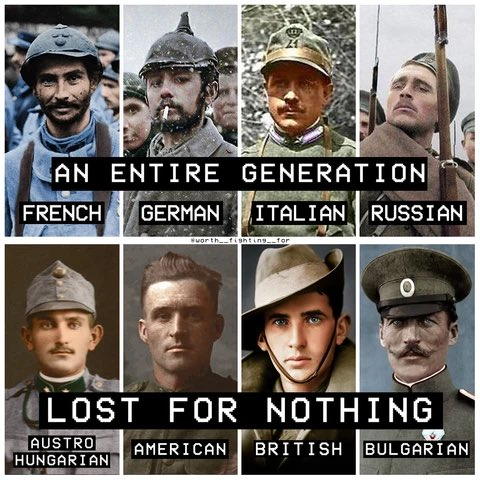
Wilfried Owen’s poem “Disabled” follows a soldier who has lost his legs during the war and is now alone and isolated. The poem uses images of color and temperature to show how the soldier changed before and after the war. The many colors and heat represent his innocence and vivacity, but after joining the military due to his search for prestige and seeing war as a game, he gets more than he bargained for through the loss of half his body, and he is now an empty, unnatural shell of his former self represented by the grayness and cold.
The soldier had an innocent life full of joy and fun, represented by color. During “this time [the] Town used to swing so gay/When glow-lamps budded in the light-blue trees” (Owen 7-8). The trees and their lamps are symbols of happiness and color. The trees give connotations of life, as they are living things and important for the environment because they absorb carbon and provide shade. Their wood is used for building and for fires to mitigate cold. The light-blue color of the trees also represent water which is another giver of life: plants and trees grow from water. The glow-lamps represent the light of life given off, or budded, by the trees. This recalls the tree of life archetype that springs up in many of the world’s major religions. Just like the tree springs off bright buds, the man used to have a bright future. The word “swinging” suggests flexibility: the man used to be flexible, a stark contrast with him currently being in a wheelchair. Swinging is also a common movement one does while dancing. He joined the military because “someone had said he’d look like a god in kilts” (Owen 25). He also wanted “to please the giddy jilts” (Owen 27). There is a smile in line 25 comparing him to God, showing just how high his hubris is. He wants people to think well of him. Kilts also have intricate patterns with many colors. A rainbow has many colors, and the color spectrum combines to white, which represents purity and God. So the man would look like a god if he wore the kilts. “Kilts” rhymes with “jilts” because these are the two reasons he wants to join the army. They also have similarities: the women are flirtatious and lively like the many colors on the kilt. The women are searching for a man, and this specific man is in turn searching for them. The word “giddy” also means silly, which both the man and the women are. Keeping in mind the many colors of the kilt, this also shows that the man wants further meaning and excitement in his life. He sees the military as just another fun game for him to play.
But the soldier’s loss of his legs leads to his loss of innocence and a life of regret and sadness, represented by gloom. When a shell blows up his legs, “half his life-time lapsed in the hot race/And leap of purple spurted from his thigh” (Owen 19-20). He has not just lost his legs and thus half his body but has also lost his innocence and has forcibly matured, almost as he has become older than he really is. The word “lapsed”, along with “race” after it, shows how fast this has occurred. The latter word also sets it up as a speed contest: the soldier had to beat the shell by moving out of the way. However, he has lost the race and thus his legs. In the next line, the purple spurting from his thigh represents the flowing blood, but the choice of colour is deliberately picked for imagery: purple is a color of royalty, prestige and grandeur. So this image shows all the soldier’s glory and potential being lost. He is no longer a prestigious winner, a young man with a bright future. It has all flowed out of him, turning him into a grim man without meaning. He feels like a loser now. The women now ignore him, preferring strong men. And he is in despair, remarking on “how cold and late it is! Why don’t they come / And put him into bed? Why don’t they come?” (Owen 45-46). The “cold” here is an interesting contrast with line 19, which has the word “hot”. The explosion in that line took away his heat of feeling, emotion and youth, and has left him the cold, old person that he is now. It is too late for him to obtain his glory and the women now. This once again alludes to how the war has aged him, despite his young physical age. He is filled with regret for having joined the war and is nostalgic for his youth, for when he was remembered before. That is why he wants the women to put him to bed. The bed also brings connotations of dreams and imagination, so he is also imagining how things were before. The poem ends with an unanswered question, further showing his despair and loneliness. It is nihilistic and sad, a fit ending devoid of heat and color.
The images of color and temperature show how the soldier has changed before and after the war. He was formerly filled with the color and fire of innocence, energy and a bright future. His hubris and excitement led him to join the war, but it burned out half of his body. He is now a sad man wallowing in despair who has lost his earlier youth and high-spiritedness, and things are no longer the way they used to be for him. This shows the effect that war has on someone’s spirits, and how it rapidly ages them. It is also a warning to be careful what you wish for, as you may get far more than you bargained for.


Leave a comment