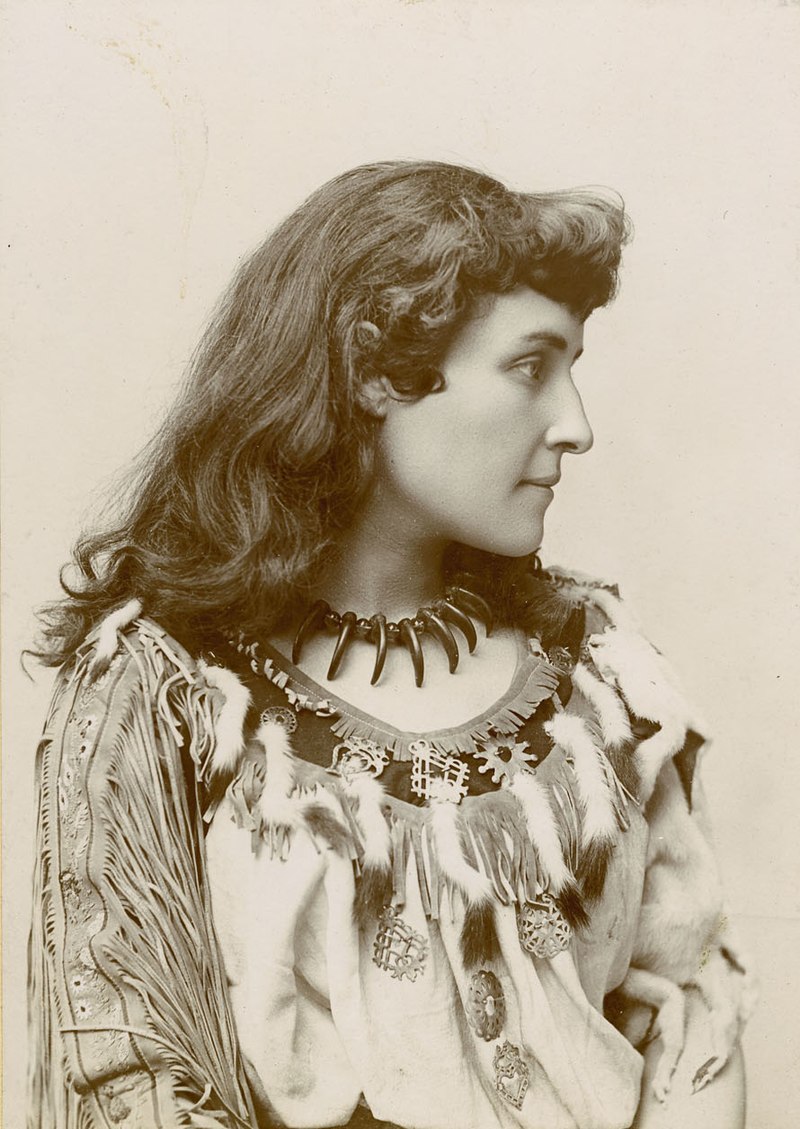
In her 1892 article “A Strong Race Opinion: On the Indian Girl in Modern Fiction” the Canadian First Nations author Pauline Johnson critiques the narrow, stereotyped representation of Indigenous women in fiction. She wrote a counter narrative in her short story “A Red Girl’s Reasoning”. In mainstream Amerindian stories written by white Canadians at the time, the “Indian Girl” was often portrayed as submissive to the white man, an Uncle Tom often driven to self-destruction at the end. This paper argues that the Indian girl in Christine’s story was framed like this in the story’s beginning, but later broke convention by rationally standing up for herself and her people by leaving him, while Charlie is ironically driven by passion. Christine is servile to her husband Charlie, ornamentalized and infantilized. But once her parent’s marriage is called into question and her people’s traditions denigrated, Christine, in a break from mainstream stories, refuses to submit to Charlie and his insults and stands up for herself and her people. Charlie’s passion and emotion makes him submit to unhappiness and mania at the end of the story, while it is Christine who is a reasoning, thinking being.
Johnson at first frames Christine with the same kind of stereotyping and blandness that she so strongly critiques in her article. She complains that unlike other races, the Indian girl is not permitted “spontaneity, she must not be one of womankind at large, neither must she have an originality, a singularity that is not definitely ‘Indian’” (Johnson, A Strong Race Opinion 1). This mainstream Indian woman, named “Winona”, has a “self-sacrificing life”, being “always desperately in love with the young white hero” although he never marries her (Johnson, A Strong Race Opinion 2). The Indian girl is “doglike”, “crouching” and “submissive”. Jimmy Robinson gives his daughter Christine to Charlie, saying that he has “owned” her and describing her as “a little piece you are stealing from me today” (Johnson, A Red Girl’s Reasoning 1). Charlie had won “the quiet little daughter” of Jim Robinson (Johnson, A Red Girl’s Reasoning 2). In both passages Christine is seen as an ornament, given to Charlie as the pinnacle of his collection of both Indian relics and knowledge. She is a prize that he has won. Christine has an “almost abject devotion” to Charlie, for which he is proud of her. Because of her exoticism, she is “all the rage” at the provincial capital (Johnson, A Red Girl’s Reasoning 3). At the Lieutenant Governor’s Dance, Mrs. Stuart says that an Englishman is “not half as interesting as a foreigner, or native” (Johnson, A Red Girl’s Reasoning 5). Stuart is stealing Christine’s connection to her own Canadian land by calling her a “foreigner”. She and Charlie see Indians as timeless and exotic, similar to Orientalism. They simply want the Indian for their own enjoyment as something from the past but fail to appreciate the living culture. This is what Lenore Keeshig-Tobias complains about: the Canadian cultural industry stealing native stories “as surely as missionaries stole their religion, the politicians stole their land and the residential schools stole their languages”. Stories “reflect the deepest, most intimate perceptions, relationships and attitudes of a people, showing how a culture thinks” (Janes Slides 9-10). Mrs. Stuart and Logan find her parent’s native marriage shocking. Christine is described as a “poor, shivering, pallid little woman” when she leaves with Joe after Charlie finds out about her parents’ marriage (Johnson, A Red Girl’s Reasoning 6). This implies that Christine’s fate will be the same as all other Indian girls. Christine at first is no different from the conventional Indian woman, and has her culture stolen in a way from her.
It is later in the story that Christine breaks convention with the conventional “Winona”. The latter is “possessed with a suicidal mania” at the end of her story, with her “unhappy, self-sacrificing life becoming such a burden to herself and the author that this is the only means by which they can extricate themselves from a lamentable tangle” (Johnson, A Strong Race Opinion 2). There is always “the inevitable doom that shadows her love affairs”. She loves the white hero so much that “she is treacherous to her own people, tells falsehoods to her father and the other chiefs of her tribe, and otherwise makes herself detestable and dishonorable” (Johnson, A Strong Race Opinion 3). Johnson wishes to read something that has the North American Indian “besting” someone (Johnson, A Strong Race Opinion 6). Indeed, Christine does best Charlie during their argument about rationalism: when Charlie accuses her of “disgracing him”, and later calls their marriage into question, she tells him they are not married, asking him: “why should I acknowledge the rites of your nation when you do not acknowledge the rites of mine?” She throws away their marriage ring and leaves him (Johnson, A Red Girl’s Reasoning 9). As noted by Nason and Fee, Christine’s stance supporting “not only the equality of nations but also […] of men and women”, was “the backbone of Six-Nations alliances” (Janes Slide 21). Christine had no problem with Charlie’s Christian traditions, having married him under them and adopted them herself. She had made a sacrifice for him, and all Charlie had to do was to respect her Indian traditions and her parent’s marriage. Christine gave, but she did not get, so to preserve her self-respect she left the marriage. Charlie finds her at the end of the story in a cottage, and insists and begs that she return, but Christine is unmoved, telling him that “neither church, nor law, nor even (…) love can make a slave of a red girl”. Christine does not take this stance lightly: she looks at Charlie “as the Law Giver must have looked at the land of Canaan outspread at his feet” (Johnson, A Red Girl’s Reasoning 12). Moses in the Bible wanted to enter the land of Canaan, but God prevented him from doing so. In the same way, Christine still loves Charlie but because he refuses to admit his wrongdoing, and the legitimacy of her parents’ Indian marriage was legitimate, her honor and freedom prevents her from returning to him.
It is Charlie who has the sad fate that normally befalls the Indian girl, because he gives in to his emotions. When Charlie is arguing with Christine earlier in the story, he does not do so with logic, but with emotional ad hominem insults, calling her father a “fool” for not insisting upon the law and calling her “worse than blasphemous” (Johnson, A Red Girl’s Reasoning 8). He then grabs her wrists in anger, with his brother telling him that he is acting “like an infernal fool”. Charlie only proves his wife’s point that he is dishonoring her and treating her like a “squaw” (Johnson, A Red Girl’s Reasoning 9). He is offended by the truths that his wife is speaking. His voice had “earlier been like an angry demon”, now he is behaving like one (Johnson, A Red Girl’s Reasoning 7). But later, when Christine leaves him, Charlie is consumed by agony. When he finds her, he is crying and groveling at her, and when he hugs her, “his despairing face sank” onto her arm, his cheek “hot as fire” and her arm “cool “ (Johnson, A Red Girl’s Reasoning 12). The fire, which is a metaphor of his uncontrollable emotion and passion for Christine, attempts to melt the cold discipline and demeanor of Christine but is unable to. So, the flames will consume him instead. They represent Charlie’s failure. His agony is “a death sentence” (Johnson, A Red Girl’s Reasoning 12). The dog that Charlie rescued “licks at his sleeve” (Johnson, A Red Girl’s Reasoning 13). This is an analogy of when he had groveled for Christine, and this shows that he has become like a dog to her. It may also show that Charlie does not deserve to have a human partner, only an animal partner. The dog and Charlie are fit for each other. Charlie’s story has ended now.
Christine at first wears the skin of the traditional submissive Indian girl who has her culture stolen from her. But later in the story, she sheds the skin and rationally defends her people against Charlie’s denigrations, insisting on equality. Charlie himself is driven by greed and passion, and in the end of the story falls to it. She shows through this that her people and way of life have not become passive and obsolete but are very much active and will continue fighting to preserve their traditions. She argues that marriage is a mutual bond and that both sides must sacrifice equally, and that if the husband does not, then there are consequences. The story can also be a way for Johnson to deal with the ambivalence that she felt as an Indian and British woman. Through this amazing story, Pauline Johnson opened a new path for the Indian girl, and in this vein is sort of an innovator in her genre.
Works Cited
Janes, Daniela. “E. Pauline Johnson – Tekahionwake.” ENG352. UTM, 21 January 2021. Lecture.
Johnson, Pauline. “A Red Girl’s Reasoning.” Canadian Literature. Vancouver: Canadian Literature, March 2013. PDF Document.
—. “A Strong Race Opinion.” Vancouver: Canadian Literature, April 2013. PDF Document.


Leave a Reply