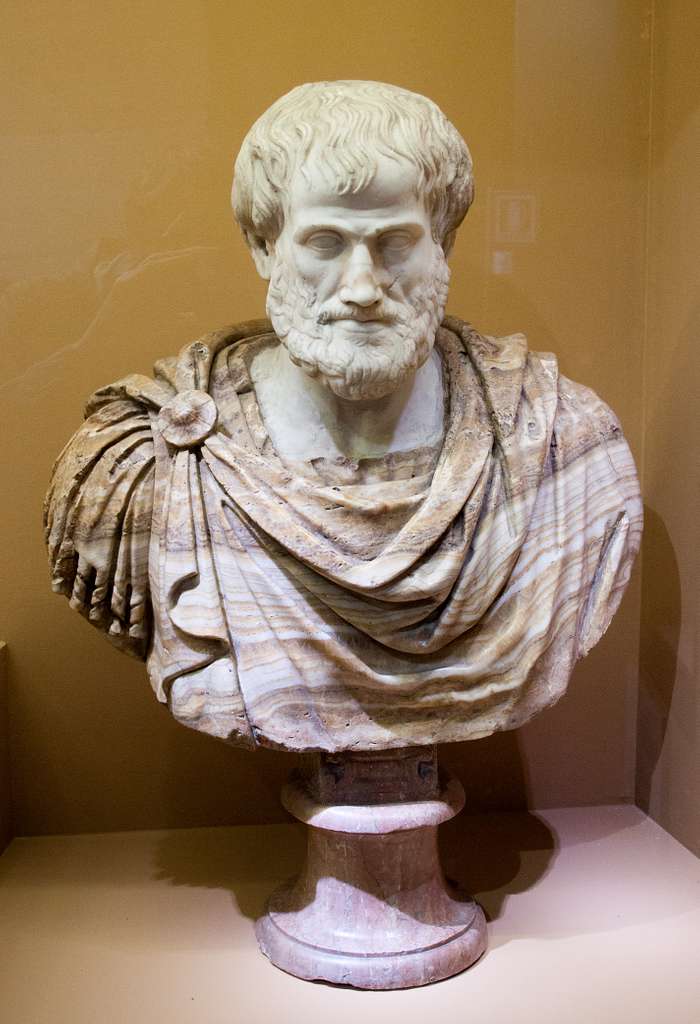
Aristotle (c. 384-322 BC) was an ancient Greek philosopher, perhaps the greatest in history. He invented the idea of separate academic disciplines, dipping his toes into philosophy, politics, ethics, biology, natural sciences, aesthetics, poetry, and metaphysics. In contrast to his master Plato, who focused on the ideal otherworld, Aristotle focused on the real, particular world. To him, things exist only in the material world, not in supernatural Forms, and one has to observe them to find knowledge. Someone looks at many apples to abstract the form of an apple. Thus, all of Aristotle’s ideas in natural science, philosophy, ethics, and politics were informed by his realism and empirical observations. He and his students gathered objects ranging from plants, animals, historical documents, and Greek constitutions to study them.
Aristotle made breakthroughs in natural science through his observations and classifications of phenomena and creatures. Meteorology was one of his subjects, which included not only the examination of weather, but of every aspect of air, water, and the earth. In his treatise Metaphysics, Aristotle tried to explain strange weather naturally. In his History of Animals, he meticulously categorized animals into different species and subspecies, detailing their movement, reproduction, eating and relieving habits, senses, genetics, sleep, etc. Aristotle was the first person to classify animals in such a detailed manner, although many of his theories on them were wrong, such as female animals having less teeth than males, sensation coming from the heart rather than the brain, eels being spontaneously created, and mice dying if they drink in summer. Aristotle’s division of species into those having and lacking red blood, calling the former vertebrates and the latter cephalopods, was also of questionable accuracy. However, Aristotle’s classifications were mainstream in biology for hundreds of years. Aristotle made more accurate discoveries of marine life, studying sea creatures by dissecting them. Aristotle differentiated the souls of plants, animals, and humans. Souls make a thing living as opposed to inanimate. Plants have purely nutritive souls: they absorb the nutrients they need from the sun and rain, but do nothing else. Animals have nutritive and sensitive souls, with the latter meaning that they can feel things and respond to stimuli. But only humans have a soul that is rational in addition to the other two qualities: we can reason, observe evidence, and come up with conclusions based on it. This was important for Aristotle’s ethical ideas, as he believed the greatest life made full use of the unique human gift of reason. Aristotle’s hierarchy of life, the Great Chain of Being, was mainstream in Western philosophy all the way into the Middle Ages.
Aristotle invented many key concepts and much of the language of Western philosophy. His goal was to create a simple reasoning system that would allow the discovery of everything possible. This involved describing objects by their qualities, conditions, and behaviors. His analysis of change bridged the perspectives of Parmenides, who believed it didn’t exist, and Heraclitus, who believed it was constant and unceasing. Aristotle introduced the potential of change: for example, a seed has the potential to grow into a plant, and nutrients from falling rainwater and the sun can actualize the potential to make that happen. This explanation would later be important for St. Thomas Aquinas’ proofs for God’s existence. Aristotle outlined a distinction between the essential and accidental properties of an object. For example, a pencil’s essential property is its lead, which is used for writing and drawing. The pencil can be any color, but this is an accidental property of it. A woman’s essential qualities are a vagina and ovaries. Her skin or hair color or height are accidental properties that do not impact her sex. Aristotle invented the theory of hylomorphism which divides the qualities of objects into their matter and form. The former is what the object is made of while the latter is the actual object itself. For example: a statue is a form, and its matter can be marble. Aristotle outlined the process of causation. For instance, a carpenter can be an efficient cause of an object. He uses wood, which is the material cause, to build a table, the formal cause. The final cause of the table is its purpose to hold objects. Aristotle created rules of logic, with his Organon being the key text on this subject for millennia. He discovered and outlined the syllogism, or necessary inference of a conclusion from a major and minor premise. The fact that all cows eat grass can be a major premise. Brenda being a cow can be the minor one. Therefore, the conclusion is that Brenda eats grass. Aristotle outlined logical fallacies in his Sophistical Refutations. Affirming the consequent is one: sometimes A equals B, but not the other way around. If you study at Harvard, you are studying at an Ivy League university. But if you are studying at an Ivy League university, you are not guaranteed to be studying at Harvard. Another logical fallacy mentioned by Aristotle is the fallacy of the undistributed middle: both taxi drivers and Grand Prix competitors drive cars, but it would be wrong to assert that this means all taxi drivers compete in the Grand Prix. Aristotle provided Western thinkers a vocabulary with which to classify objects and construct rational arguments.
Aristotle presented a form of living the “good life” in his Nicomachean Ethics. Rather than being a strict moral code, it makes propositions while encouraging the individual to exercise their own judgement to live a good life. Aristotle’s observations of human nature informed this work. He claimed that people strive for a good when they act. However, most goods are instrumental, meaning that they bring another benefit. For instance, you buy a car so you can get to work. You work so you can earn money to purchase food, water, and shelter to survive. All of these are instrumental benefits. The ultimate good is happiness, or peace with one’s life. Happiness is not obtained through honor, as honor is dependent on others rather than ourselves, and you could be honored for something you didn’t do. Pleasure doesn’t bring happiness either, because such a life is fit merely for animals. Happiness doesn’t come from wealth because working for money is mandatory to survive rather than self-chosen. People obtain the most happiness by exercising their reason to practice virtues, as this is the unique function of humanity. One must be disciplined into virtue until it becomes a habit. Aristotle defined the golden mean, which is the median between a life of materialism and abstinence, two problematic extremes. Every virtue is a mean between extremes: bravery is between cowardice and heedlessness, moderation between indulgence and deprivation, and charity between extravagance and miserliness. Aristotle calls these moral virtues, different from the intellectual virtues like knowledge, wit and wisdom. A moral individual needs both to choose the right course of action. Justice is not a virtue in itself, but is made up of all the other virtues. There is no vice that involves being too just. Aristotle said that every individual must find the proper action based on their circumstances. For instance, a young martial artist should neutralize a thief who is robbing a woman, but it might be too dangerous for an 80-year-old man with a walking cane to try to do so. Aristotle sees friendships based on virtue as superior to ones based on interest or pleasure, as those are fleeting. Friends can improve their virtues by practicing them on each other. Aristotle was unique in giving the individual some leeway in finding the good life rather than prescribing a rigid, strict moral code, and in saying that moderation must be exercised rather than full abstinence from all pleasure, which his predecessor Plato almost said.
Aristotle also wrote Politics as a guide for statesmen. This work describes human interaction with society and government. Aristotle believed governments had to foster virtue and happiness among their citizens. He was unique in explaining the creation and function of the city state rationally, away from the ancient idea of cities founded and protected by gods. This was in line with the Greek approach of looking at natural rather than supernatural causes of phenomena. Aristotle saw the city-state as a natural creation of human nature. He disagreed with Plato’s ideal state, saying that it would be unable to prevent strife between the ruling class (the guardians and auxiliaries) and the commoners, as it separates them and only allows the former to have education. Instead of dreaming up an ideal state, Aristotle examined three real systems and three degraded versions of them. The good systems put the common interest of the people first, and are bound by the rule of law, while the perversions put only a faction first. A system ruled by one man is a monarchy, which Aristotle calls the best form of government since one virtuous ruler can stop disputes. Tyranny is when the monarch rules arbitrarily only for himself. A system ruled by a few is an aristocracy, while the perverted version, where the rich handful govern only in their own interests, is an oligarchy. A system ruled by the multitude is a polity, while the perversion is a democracy, where the poor use the government to loot the rich. Aristotle, like Plato, was suspicious of democracy and oligarchy, fearing that both pitted the poor and rich against each other. He also worried that demagogues appealing to emotions could take over the former system. To Aristotle, the rule of law reigned supreme over any man, as it was informed by God and reason, while the rule of a man could be arbitrary and subject to his passions. Therefore, all rulers had to be bound to the law. Aristotle also favored a strong middle class that was bigger than the other two classes, as it could check their extremes. This fits with his golden mean, showing that he prized moderation over excess in everything. Aristotle believed all three forms of government could work as long as they ruled virtuously and served the people. His views on government inspired the US Constitution’s checks and balances.
Aristotle was a foundational philosopher of the West and a polymath with broad areas of focus, including philosophy, ethics, natural sciences, and politics. What made his ideas in each field unique is that they were realistic and formed by empirical observations rather than ideal rationalism like his predecessor Plato. Aristotle found great success, tutoring Alexander the Great before opening his own school in Athens called the Lyceum, where his students did extensive research on his subjects of study. Aristotle provided the West an understanding of the natural world, philosophical language, a moderate, individualistic form of ethics, and an idea of government checked by law. So influential was Aristotle that more than a thousand years later, when St. Thomas Aquinas spoke of the philosopher, everyone knew he referred to the Greek. The American Founding Fathers took inspiration from Aristotle in the Constitution, particularly its three branches of government and Bill of Rights.


Leave a Reply