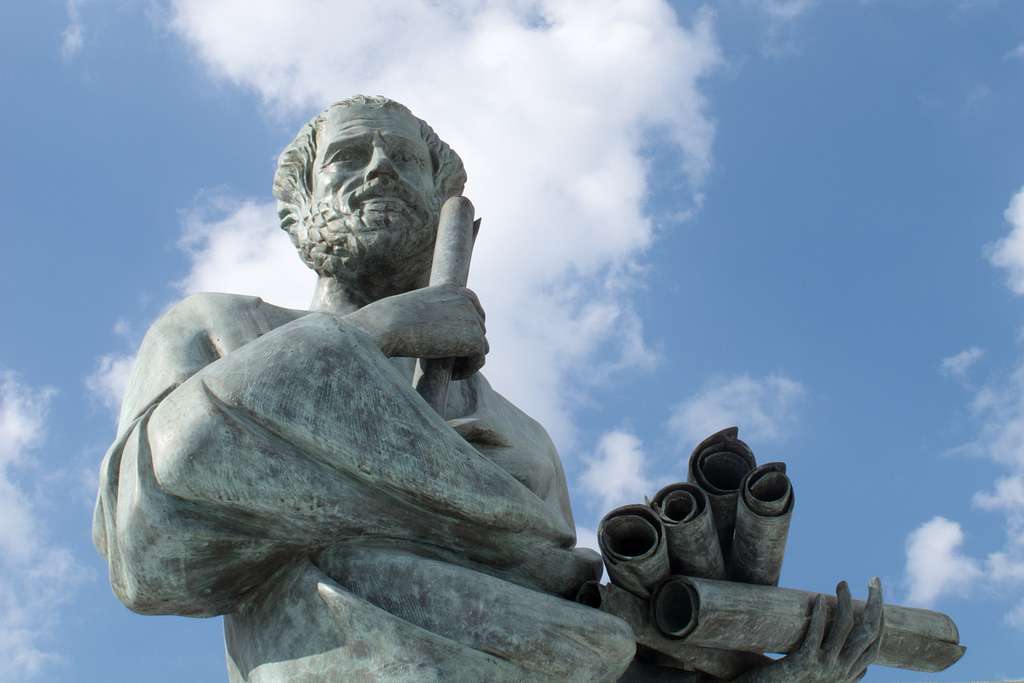
Libertarians, or “Aristotelian liberals”, have used Aristotle’s ideas to argue for liberty, despite the fact that he was not a libertarian. They have cited Aristotle’s observation of humanity’s unique capacity to exercise reason. Free, rational people obtain happiness through practicing virtue with others in a state that fosters their well-being, a basis for the libertarian desire to maximize individual freedom by restraining government. Aristotle believed choosing virtue brings happiness, fitting the libertarian view of individual responsibility. People must freely choose to learn these virtues, which libertarians use to argue against coercion. Finally, Aristotle’s ideal government is bound by the rule of law, reflected in libertarian constitutional limited government.
In his Nicomachean Ethics, Aristotle said that humans obtain the most happiness through choosing virtue, which libertarians cite for their belief that people control their own destiny. People do one thing to get another, like obtaining education to earn money to survive. The ultimate goal is happiness, or eudemonia. We attain it by living the best life, where we use our reason, the unique gift of humanity, to act virtuously. Pleasure is slavish, honor depends on others, and money is required for basic survival, so these do not bring happiness. Virtue brings happiness because it is freely chosen. While Aristotle saw the best life as involving the worship and contemplation of God, he recognized this as unattainable for most people, so he advocated the active practice of virtue. Libertarians would agree with this, as they believe all individuals have rights coming from God or self-ownership, independent of any earthly authority. Because of these rights, individuals are in charge of their own destiny. Libertarians believe a fulfilling life comes from contributing to society by working, and people have to do it on their own, not just depend on others by, for example, sitting around and getting welfare from the government if they don’t need it. The individual rises or falls on their own terms. They “pull themselves up by their bootstraps”, as the saying goes. To libertarians, individuals are rational enough to find success, and they hold up independent businessmen and entrepreneurs as their models. Most people in general think a free, happy individual is in control of their own life by being financially secure with a family. Aristotle and libertarians foist responsibility on the individual.
Aristotle’s belief that one learns the virtues through their own free is used by libertarians to argue against force. Aristotle said there are two types of virtue: those of the intellect and morality. The former are taught by one’s elders, and include intelligence, wisdom, understanding and discernment. These virtues need time and familiarization to develop. The latter type of virtue comes from habit, and includes generosity and temperance. It does not come naturally to an individual, so it must be learned through practice. Virtue can be taught by a morally sound society, but ultimately people must freely choose to act virtuous. Scholars Douglas Den Uyl, Douglass Rasmussen, and Roderick Long argue that this is libertarian in their book Liberty and Nature: An Aristotelian Defense of Liberal Order. Libertarianism teaches that people are free due to their natural rights, so no one can force them to do something or hinder their actions. People must be allowed to freely choose to act virtuously to find true happiness. Being coerced to act virtuously doesn’t make someone virtuous, because they are doing it against their will, so they do not actually learn it. They have to be given the chance even to fail. Thus, the individual has rights for their own good. This can be seen in the Bible, where God gave angels and humans free will, even as Satan turned against Him while Adam and Eve ate the Forbidden Fruit against His warnings. God didn’t want to create automatons, but people who freely love Him. A rational person must interact with others by persuading instead of forcing them to do the right thing. To Aristotle, friendship was important for the development of virtue. True friends practice virtues on one another to improve each other’s character. They have a relationship by free choice, otherwise it is not a true friendship. People must be friendly with each other because cooperation among citizens is the foundation of the polis. Aristotle’s idea of virtue being developed by individual hard work fits the libertarian insistence on free will.
Aristotle’s preferred government practices virtue, giving libertarians a foundation for limited constitutional government. In his Politics, Aristotle discusses the polis, which he sees as superior to the individual, family, and village because it is self-sufficient, while these other units need things outside themselves to thrive. In contrast to libertarians, who believe the state should only be a night-watchman that protects peoples’ rights, Aristotle’s state works towards the cultural and material fulfillment of its citizens, and can use coercion. He believed that the best government allowed men to act virtuously and find happiness. Aristotle’s true forms of government, which are the monarchy, aristocracy, and polity, rule for all people and are bound by the rule of law. Their leaders practice virtue, so people imitate them, and there is strong trust among the citizens. The three despotic forms, which are tyranny, oligarchy, and democracy, ignore the rule of law and govern for one faction at the expense of everyone else. Because the leaders violate virtue, the people do the same, and they distrust each other. Aristotle believed that a strong middle class balanced against oligarchies and democracies. It was the bedrock of his final form of government, a polity, which joined the good parts of oligarchy and democracy. Aristotle’s rule of law, which applies to all people regardless of status, is in line with the libertarian idea that the state must protect individual rights. In his book Justice and Right in Aristotle’s Politics, Fred D. Miller argued that Aristotle believed in individual rights. To ensure their protection, the state must be bound by a constitution that limits government power. The individual’s rights cannot be sacrificed to those of the wider community. Only a government that its citizens consent to is legitimate. If the government ignores its citizens’ innate rights and starts abusing them, it is no longer legitimate, and the people can get rid of it. Libertarians also believe in a limited government that stays out of the way of productive people like entrepreneurs, oppose regulations and taxes that hinder their work. This allows a nation’s citizens to fulfill their potential, which Aristotle valued.
Aristotle’s philosophical and political ideas provide a strong foundation for libertarianism. His belief that happiness comes from freely choosing to practice virtue in a moral state is used by libertarians to argue for individual freedom from coercion and a small government bound by a constitution. To Aristotle, virtue brings happiness because it is chosen, fitting the libertarian view of responsibility. People must learn virtue by choice, supporting the libertarian opposition to coercion. Aristotle’s best government governs for all people and follows the rule of law, just like a libertarian government is limited, follows a constitution, and protects individual rights. Aristotle’s views on government formed the basis of resistance theory, formulated by early modern intellectuals like John Ponet.


Leave a Reply