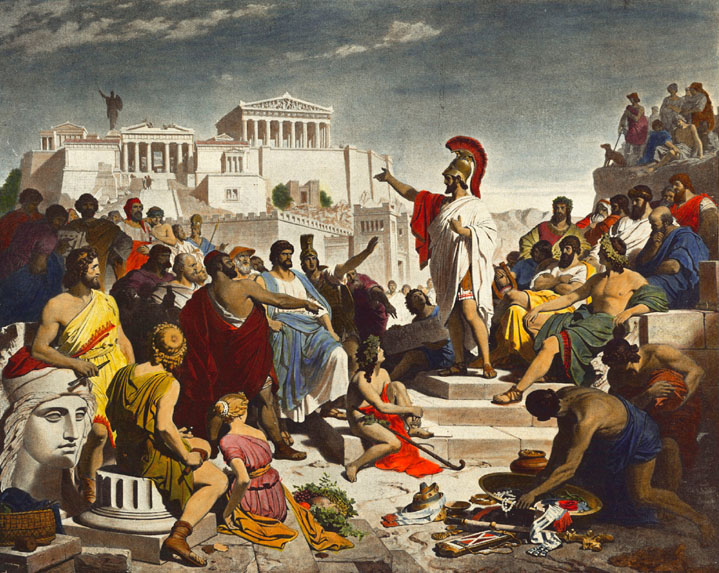
In 430 BC, during the funeral of Athenian soldiers after the first battles of the Peloponnesian War, Athens’ leader Pericles made a speech on the glory of Athens and its democracy. Pericles argued the Athenians were a brilliant people who valued liberty, leisure, knowledge, and generosity. Pericles lauded Athens’ democratic system as fair and an outgrowth of the natural Athenian love of liberty. He added that the Athenian people took time for leisure and avoided overwork. To Pericles, this balance was due to the intelligence and virtue of the Athenians, making Athens the Greek world’s center. He boasted of Athen’s openness and generosity, but also betrayed hubris in bragging about its expansion.
Athenian Democracy and Liberty
Pericles portrayed Athens as unique because of its democracy and liberty. He said the city-state “favors the many instead of the few”, and had laws that provided “equal justice”.[1] An Athenian did not escape the consequences of committing a crime just because they were rich or part of a higher class. Someone in Athenian society could advance from their “reputation for capacity, class considerations not being allowed to interfere with merit”.[2] This made Athens a meritocracy, where the most talented people made up the elite. All citizens of Athens had the privilege of serving in the Assembly, where they could speak and vote. Athens was a direct democracy, where rather than voting for others to make decisions, Athenian citizens made the decisions themselves. They also had the possibility of being chosen by lot yearly for various institutions and offices, like law courts, magistrate offices, and the Council of 500 which decided issues for the Assembly to vote on.[3] Many administrative tasks were later transferred to the Council from the aristocratic Areopagus, the highest court in Athens. While only a quarter of the population had citizenship, and females and slaves were excluded, this was still a radical, advanced system for its time. Plus, magistrates were held accountable for their actions, and officials had begun to receive payment for their services, allowing non-wealthy people to hold political offices. Tax laws were also relaxed for the lower classes.[4] Because of its relative fairness, the Athenian constitution was a model for other states.
Pericles added that an Athenian was free to do “what he likes”, though they still knew to obey the laws, “whether they are actually on the statute book”.[5] Athenian society was individualist and allowed great liberty to its citizens, but this was only because they were virtuous and mature enough to exercise it. It has long been a common theme among Western thinkers that liberty is only possible with an educated and moral population. Athens also had a limited and relatively homogenous population, which made its democracy easier. Pericles alluded to natural law, a favorite theme of Greek philosophers going back to Heraclitus. They saw the universe as an ordered whole bound by this unwritten law, referred to as logos, a name which would later be adopted for the word of God in Christianity. They believed humans possessed the rationality to discover this natural law and act according to it. Later in the speech, Pericles lauded the dead Athenian soldiers for “choosing to die resisting, rather than to live submitting”.[6] He portrayed Athenians as having a natural disposition to liberty, and the bravery to die to defend it. To Pericles, the Peloponnesian War was about defending Athenian liberty against Spartan despotism, just like the earlier Persian Wars. Another Greek cultural pillar Pericles hinted at was arete, or the individual search for glory, present in epics such as Homer’s Iliad where heroes like Achilles and Hector pursue it. By grounding democracy in liberty and natural law, Pericles portrayed it as natural to Athens.
Athenian Love of Leisure
Pericles referred to the value of leisure in Athenian life. He said that Athens provided “plenty of means for the mind to refresh itself from business” including “games and sacrifices all the year round” and luxurious “private establishments” which “forms a daily source of pleasure and helps to banish the spleen”.[7] Athens boasted buildings like the Parthenon and Propylaea, which Pericles built as part of his beautification of the city. Athens was a major participant in the Greek Olympics, and hosted its own Panathenaic games. Festivals and public religious rituals like the sacrifice of bulls and other animals were very important in Athenian life. Pericles echoed the Athenian belief that life was not just about toil, but also enjoyment, especially as a reward for hard work. The beauty of Athens gave its citizens a sense of wonder and a stake in its protection and flourishing. Athenians aspired to be men of leisure. Pericles noted that “the magnitude of our city draws the produce of the world into our harbor, so that to the Athenian the fruits of other countries are as familiar a luxury as those of his own”.[8] This alluded to the massive importance of trade in Athens, despite the Greeks generally holding trade and commerce in contempt. Athens only produced enough grain to feed ¼ of its own population, so it relied on imported food. But Athens also imported luxury products, and was connected to the wider world as head of an empire. Athenian leisure was made possible by this trade.
Pericles differentiated Athens from its “rivals”, who, “from their very cradles by a painful discipline seek after manliness”.[9] He was referring to Sparta, which oriented its entire society around the military, and had a strict regimen for its warriors from the age of 7. The state even reserved the right to kill newborn babies if they showed any defects. Sparta was very austere and devoted less attention to culture than Athens. Athens did not demand such harsh discipline from its citizens. The implication of Pericles’ argument was that the Spartans were weakened by overworking themselves, while the Athenians were stronger by conserving their energy. Pericles said that the Spartans “brought all their confederates” when it invaded “our country”.[10] This referred to the invasion of Athens in the previous year by the Peloponnesian League, led by Sparta, which Pericles responded to by having the Athenians hide behind the Long Walls he had built while the city-state’s navy fought the Spartans. This ingenious strategy, which involved patience and use of the sea, worked at the time. In contrast to the Spartan approach, the Athenians “advance unsupported into the territory of a neighbor” yet “usually vanquish with ease men who are defending their homes”.[11] Pericles was mentioning the extraordinary military power of Athens, which dated back to the Persian Wars several decades earlier when it had taken the lead in defeating the Persians, and continued all throughout the century, winning the city-state its empire. Pericles added that Athens’ enemies never encountered its united force as the city-state had “to attend to our marine and dispatch our citizens by land upon a hundred different services”.[12] Athenian citizens were not always available to fight, because the city-state devoted itself to cultural pursuits and trade, yet Athens still dominated militarily, which to Pericles showed its extraordinary quality.
Athenians as an Intellectual, Virtuous People
To Pericles, Athens’ balanced quality of life was sustained by the brilliance of Athenians. He said his people “cultivate refinement without extravagance and knowledge without effeminacy; wealth we employ more for use than for show, and place the real disgrace of poverty not in owning to the fact but in declining the struggle against it”.[13] He portrayed Athenians as moderate, creating art and beauty without losing themselves in excessive luxury, and learning without neglecting their physical duties and becoming weak. The quote “the society that separates its scholars from its warriors will have its thinking done by cowards and fighting done by fools” from Sir William Francis Butler comes to mind.[14] The Athenians taught their elites many subjects to make them well-rounded citizens of the polis or city-state. This pedagogical model, called paideia, was widespread in Greece and would be resurrected more than a thousand years later in the Renaissance. Pericles channeled Aristotle’s later virtue ethics and golden mean, which defined virtue as the middle of two extremes. Pericles also alluded to how Athenians used their wealth for practical, helpful purposes instead of extravagantly displaying and wasting it. Greco-Roman cultures looked down on opulence, and criticized their Near Eastern rivals like the Persians for practicing it. Pericles boasted that the Athenians faced challenges head on rather than avoiding them. Indeed, decades earlier Athens was destroyed by the Persians, but the Athenians never gave up, later defeating their enemy and rebuilding their city so it looked more beautiful than ever. Pericles later said “the Athens that I have celebrated is only what the heroism of these and their like have made her”.[15] Pericles meant that it was the Athenian people themselves who made the city-state great through their love for it. A similar quote is G.K. Chesterton’s “men did not love Rome because she was great; Rome was great because men loved her”.[16] Athens was not in the most ideal spot geographically: as mentioned it had to import most of its food. Yet this did not stop the Athenians from making their city-state the center of the Greek world, because they were resourceful and creative with their land.
Pericles added that in Athens “ordinary citizens, though occupied with the fruits of industry, are still fair judges of public matters” and “instead of looking on discussion as a stumbling-block in the way of action, we think it an indispensable preliminary to any wise action at all”.[17] Athenian citizens were expected to be informed on politics, and the Assembly was a center of lively debate. One reason why public speaking was so important in Athens was because the city-state lacked specialized lawyers or professional judges. Athenians and other Greeks thought that an actualized man had to read and engage in philosophy, so they tended to dislike physical labor. Such work was left for others like slaves and metics so that Athenians could be free to engage in intellectual pursuits. Later in the speech, Pericles lauded Athens as “the school of Hellas”, pointing to its status as the cultural powerhouse of the Greek world.[18] Athens housed playwrights like Aeschylus, Sophocles, and Euripides, artists like Phidias, and philosophers like Socrates. Later on, the city would be home to Plato and Aristotle, who both opened schools there. Athens’ central place in intellectual life is suggested by its namesake Athena, the goddess of wisdom in Greek mythology. Philosophy means love of knowledge in Greek, and the Athenian thirst for wisdom set apart their city-state.
Athenian Generosity and Hubris
Another quality Pericles ascribed to Athens was charity. He boasted that, in contrast to “our antagonists”, “we throw open our city to the world”.[19] That is, Athens gifted its knowledge and cultural treasures to foreigners. The “antagonists” were clearly Sparta, an isolationist, self-sufficient state. A substantial number of non-citizen foreign residents called metics lived in Athens, as they were invited to work in the city-state for their skills in physical labor or trade. Many people believed that there were benefits to living in Athens and participating in its somewhat free economy. Most metics were Greeks, though a few were non-Greeks. Furthermore, non-Athenians had the opportunity to become citizens. However, this did not translate to full cosmopolitanism and inclusivity: many foreigners were still barred from citizenship and Athenians distrusted non-Greeks, who they called barbarians. Indeed, after the Peloponnesian War, when Thrasybulus liberated the Athenians from the Spartan Thirty Tyrants, he declined to give the foreigners who fought with him citizenship, although he appreciated their services.
Pericles said that “in generosity we are equally singular, acquiring our friends by conferring, not by receiving favors”.[20] He portrayed the Athenian people as altruistic. Athens had been trusted to lead the Delian League, whose constitution gave all its member city-states equal rights, including in voting. In the beginning of the League, Athens was generous to its allies, protecting them from Persia and building ships for them. Athens framed all of its actions as humanitarian, even when they became covetous. Pericles boasted that Athens has “forced every sea and land to be the highway of our daring, and everywhere, whether for evil or for good, have left imperishable monuments behind us”.[21] By this time, the city-state had acquired imperial hegemony over much of Greece and the Aegean. Athens moved the treasury of the Delian League from Delos to its own city and used its funds to finance its own shipbuilding industry, labor force, and public works. Athens exploited the League and its members by arbitrarily taxing them while refusing to grant them citizenship. Athens making itself the superior of all the Greeks was a cause of the Peloponnesian War. As Pericles showed, the Athenians justified their aggressive actions by positing their actions as moral and done for the liberty of all Greeks. Athens did not appreciate the complaints of other Greeks, because it was very proud of the sacrifices it had made in the Persian War.[22] Some cities tried to leave, but Athens forced them back in. A decade and a half earlier in 445 BC, Athens had been forced to sign a thirty-year truce, but violated it by provoking rebellions against Corinth before boycotting the small town of Megara. Finally, Sparta, Corinth, Thebes, and other Greek city-states had enough, and the Peloponnesian War began.[23] Pericles eagerly anticipated a war, believing that Athens would prevail and gain hegemony in Greece. He showed Athens’ hubris, the dark side of its ambition.
Conclusion
Pericles’ funeral oration argued that Athens was a brilliant city-state with a fair democracy, a leisurely lifestyle, a virtuous thirst for knowledge, and a generous spirit. Pericles depicted Athenian democracy as a natural result of his people’s love for liberty. He added that the Athenians conserved their energy by taking refuge in leisure. To Pericles, this was possible because they practiced virtue and sought knowledge. Finally, he spoke of Athens’ generosity towards other city-states, though he revealed his hubris by lauding its empire. Pericles could not have known that Athens’ situation would turn grim in just a year, or that the end of the war would be more than the city-state had bargained for. Yet Athens would remain an intellectual and cultural center for centuries to come.
[1] Thucydides, Peloponnesian War, Book 2.34-46.
[2] Ibid.
[3] Charles Kirchner, Western Civilization to 1500, (Barnes & Noble, 1960), 36-8.
[4] Ibid, 49.
[5] Thucydides, War.
[6] Ibid.
[7] Thucydides, War.
[8] Ibid.
[9] Ibid.
[10] Ibid.
[11] Ibid.
[12] Ibid.
[13] Thucydides, War.
[14] W.F. Butler, Charles George Gordon (London, 1889), 84.
[15] Ibid.
[16] G.K. Chesterton, Orthodoxy, (The Bodley Head, 1908), ch. 5.
[17] Thucydides, War.
[18] Ibid.
[19] Thucydides, War.
[20] Ibid.
[21] Ibid.
[22] Kirchner, Civilization, 50.
[23] Ibid, 51.


Leave a comment