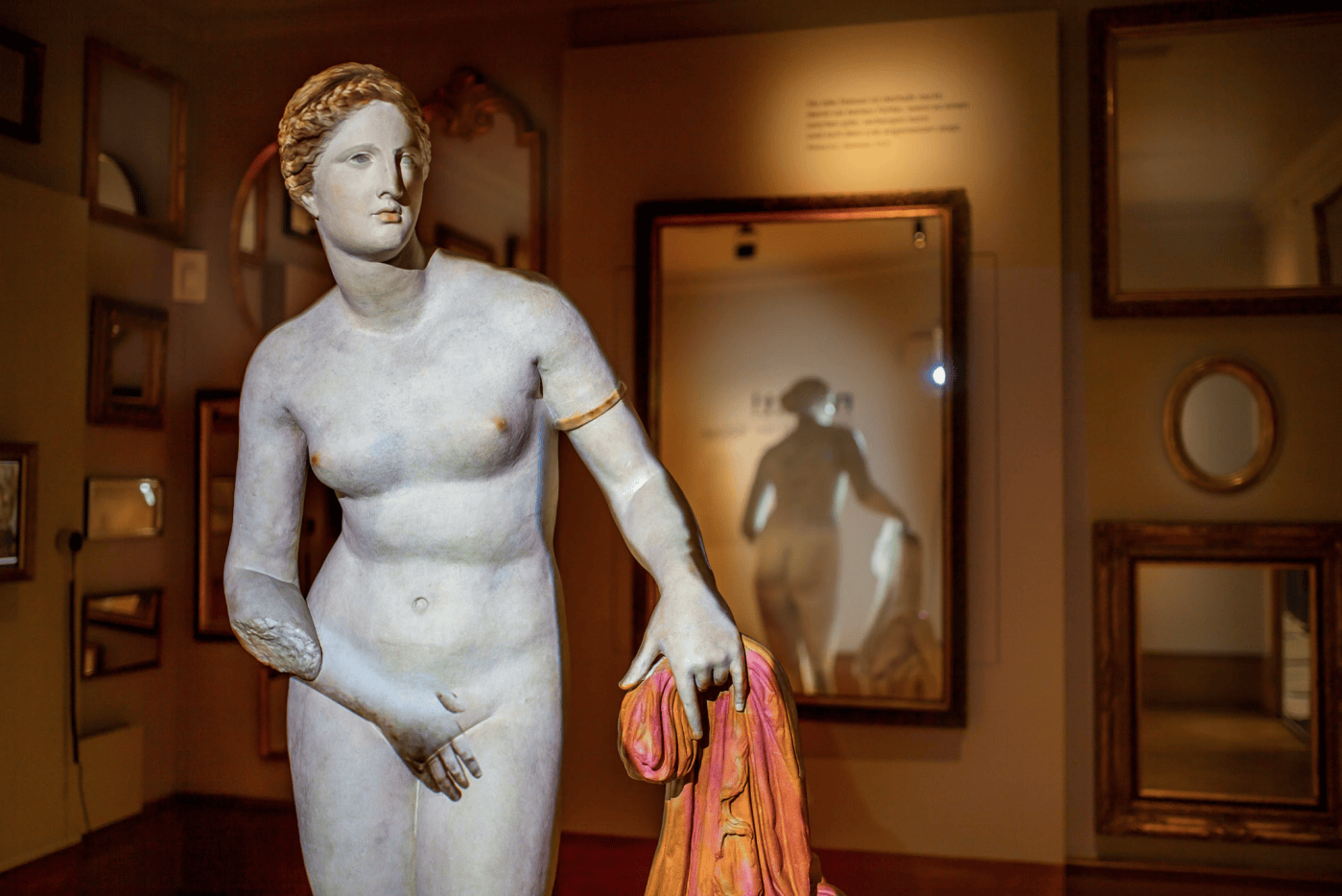
The Aphrodite of Knidos was a life-sized Classical Greek sculpture from between 360 and 330 BC, carved in Parian marble by the famed sculptor Praxiteles of Athens. It depicted the Greek goddess of love, Aphrodite, nude while undertaking a ritual bath. She covered her genitals with her right hand and with her left held a towel reaching down into a pot, while her breasts were exposed. Pliny the Elder declared this statue the greatest in the world. While the original version no longer exists, many Roman copies preserve its form, like the Colonna, Belvedere, Braschi, and Ludovisi Knidia.[1] However, none is completely accurate to the original. Praxiteles was hired to make a statue for Aphrodite’s temple on the island of Kos, and sculpted two: one showing the goddess nude and the other veiled. The people of Kos bought the latter statue as their priests wanted to encourage modesty, so the people of Knidos in Asia Minor purchased the former for their temple.[2] The statue reflected Classical Greek art through its accurate detail and sensuality.
Statues in the Classical period of Greek art during the 5th and 4th centuries BC depicted humans with more natural, detailed anatomy. However, this was combined with idealism, and realism would not dominate until the Hellenistic period. This art reflected the era’s humanistic values and association of beauty with virtue.[3] From around 500 BC statues portrayed real people.[4] Sculptors like Praxiteles added unique individual expressions and identities to their statues, culminating in real portraiture.[5] Praxiteles himself sculpted flexible, tranquil, and erotic figures, mainly depicting divinities like Aphrodite, Demeter, Artemis, Hera, Apollo, and Hermes, or mortals like Phryne.[6] His masterpiece, the Aphrodite of Knidos, was one of the first statues of a female nude in Greek history. For the previous three centuries, the naked form was reserved for heroic males. Earlier Greek art like poetry portrayed women nude, but these were courtesans or slaves rather than goddesses. While Knidos already had nude figurines of Aphrodite, Praxiteles broke new ground by depicting her bathing as an excuse to make her nude, rather than merely focusing on her reproductive and nurturing female parts like the miniatures did.[7] Praxiteles used the courtesan Phryne, his likely lover, as his model for the goddess.[8] The statue was placed in a monopteros, or a roofed colonnade without walls, within a lockable chamber, so it could be viewed from every side.[9]
The Knidia was renowned for its erotic beauty, and Lucian claimed it was so realistically sculpted “that the recalcitrant and solid nature of the stone has become adapted to each limb”.[10] The statue had a perfect 0.7-0.8 waist-to-hip ratio, with a head one-eighth its body height.[11] It was polychromed so realistically that Pliny said it resembled a real woman.[12] Its painter was Nikias, a favorite of Praxiteles notable for his deep paintings, who used chiaroscuro to highlight its attractive, polished contours.[13] A light tint may have been added to the statue’s body to simulate skin color, along with a glossy waxed polish. Aphrodite’s wavy hair, painted yellow, was wrapped in a double band and parted down the middle, exposing her forehead in a flat triangle. Her wide-ridged nose faded into curved eyebrows, while her enchanting narrow eyes, which Lucian describes as having “dewiness…together with radiance and winsomeness”, thinned into lids at their outer corners.[14] Lucian wrote that Aphrodite’s statue had “a look of proud contempt and a slight smile that just reveals her teeth”.[15] However, most Knidia have closed mouths.
Aphrodite stood in a contrapposto position, with her weight on her right foot, her left knee bent, and only the toes of her left foot touching the ground. Her left thigh leaned to her right, her hip protruded, and her head faced the left. The contrapposto was a Classical innovation, already present in works like the Kritios Boy. Statues depicted in this pose realistically twisted their shoulders and arms. Classical artists understood the human body as a system of parts acting and reacting to each other’s movements. For example, the knee bends when a foot moves. John Boardman, a famous scholar of Greek art, said about contrapposto that “someone standing in a more relaxed way is a vital novelty in the history of ancient art: life deliberately observed, understood, and copied. After this, all becomes possible”. The contrapposto characterized the Classical period’s aim for accuracy and detail in its portrayal of the human form. It conveyed self-confidence and individuality, and is actually an easier, more realistic pose to stand in than the rigidly erect one of earlier archaic statues.[16]
Aphrodite covered her genitals with her right hand “to hide her modesty” according to Lucian[17]. Greeks generally had to avoid exposing their genitals to strangers.[18] Aphrodite may have saved the viewer from the fates that befell Acteon and Tiresias when they saw Artemis and Athena nude respectively. The former was killed by his own dogs and the latter blinded.[19] The lack of detail on her vagina was a curious exception to the detail on the rest of her body. Scholar R.R.R. Smith believed that detailing her genitals “might have been deemed too immodest, or have been felt unconsciously to be sexually too aggressive”. She arguably had no need for hair in that area, since the detail in her body, like her round hips and developed breasts, showed her sexual maturity. However, two versions of the Knidia, the Venus Braschi and a small version in Malibu, preserve red pigment in the genital area. The Braschi also has an incision extending a bit to the left from the meeting point of the legs. Sculptors would choose whether to include details in the pubic area depending on the sexual and status messages they wanted to express.[20]
Aphrodite’s armband, present on her left arm, was gilded and depicted as having jewels with magical purposes.[21] Her towel was likely purple, as that is the color preserved in the pigment of the statue’s copies. The towel falling over the jar had a sexual meaning, as Greek medical literature portrayed the uterus as an upside-down jar and named anatomical features after corresponding parts of the vessel.[22] The jar represented Aphrodite’s cleansing through her bath, her fecundity and her eternal youth. Meanwhile her nudity reflected her origins in the sea and aid to seafarers.[23] It also shows she is seductive and sexually powerful. K.O. Müller said that “in the unrobed Aphrodite Praxiteles combined the utmost luxuriance of personal charms with a spiritual expression in which the queen of love herself appeared as a woman needful of love and filled with inward longing”.[24] The Knidia promoted marriage, reproduction, and fertility.[25]
The statue of Aphrodite was Knidos’ most famous landmark, and people flocked to the city to see it.[26] Nicomedes I of Bithynia offered to pay Knidos’ debts in exchange for the statue, though the Knidians declined.[27] People like Nigel Spivey have argued that the Aphrodite of Knidos was aimed towards male onlookers, and ancient sources confirm that it sexually aroused them. They may have seen the statue as a representation “of their mistresses”.[28] One man was so inflamed with sexual passion he broke into Aphrodite’s temple at night and tried to have sex with the statue, leaving a stain. When he was caught, he jumped off a cliff near the edge of the temple in shame.[29] Women may have recalled their own prenuptial baths when seeing the statue.[30] Even Aphrodite was said to have travelled to Knidos to see her representation, and Plato wrote an epigram of her asking “where did Praxiteles see me naked?”[31] The statue was moved to Constantinople in the 4th century AD, and possibly destroyed with the Palace of Lausos in a fire in 476 AD. But as mentioned, there are many variations of the statue, including miniatures made of stone, clay, and bronze, along with images on coins. It has served as an inspiration for many artists throughout Western history, including in the Renaissance.[32]
Bibliography
Havelock, Christine Mitchell. The Aphrodite of Knidos and Her Successors. University of Michigan Press, 1995.
Humanities LibreTexts. “3.4: Aphrodite of Knidos.” Last modified May 21, 2026. https://human.libretexts.org/Courses/Miami_Dade_College/Art_History_in_Student_Voices/03%3A_Femininity_in_Art/3.04%3A_Aphrodite_of_Knidos
Littleton, Covington Scott. Mythology: The Illustrated Anthology of World Myth & Storytelling. Duncan Baird Publishers, 2002.
Seaman, Kristen. “Retrieving the Original Aphrodite of Knidos.” Atti Della Accademia Nazionale Dei Lincei, Rendiconti Classe Di Scienze Morali, Storiche e Filologiche, Ser. 9 Vol. 15 (2004).
Shore, A.F. “Western sculpture – Greek, Roman, Hellenistic.” Encyclopedia Britannica. August 24, 2026, https://www.britannica.com/art/Western-sculpture.
Spivey, Nigel. “8. Revealing Aphrodite.” Understanding Greek Sculpture (Cambridge University Press, 2014).
Wikipedia. “Ancient Greek art”. https://en.wikipedia.org/wiki/Ancient_Greek_art.
“Aphrodite of Knidos”, Wikipedia, https://en.wikipedia.org/wiki/Aphrodite_of_Knidos.
“Classical Greek sculpture”, Wikipedia, https://en.wikipedia.org/wiki/Classical_Greek_sculpture.
“Praxiteles”, Wikipedia, https://en.wikipedia.org/wiki/Praxiteles.
[1] “Aphrodite of Knidos,” Wikipedia, https://en.wikipedia.org/wiki/Aphrodite_of_Knidos.
[2] Covington Scott Littleton, Mythology: The Illustrated Anthology of World Myth & Storytelling (Duncan Baird Publishers, 2002), 167.
[3] “Classical Greek sculpture,” Wikipedia, https://en.wikipedia.org/wiki/Classical_Greek_sculpture.
[4] “Ancient Greek art,” Wikipedia, https://en.wikipedia.org/wiki/Ancient_Greek_art.
[5] A.F. Shore, “Western sculpture – Greek, Roman, Hellenistic,” Encyclopedia Britannica, August 24, 2026, https://www.britannica.com/art/Western-sculpture.
[6] Ibid; “Praxiteles,” Wikipedia, https://en.wikipedia.org/wiki/Praxiteles; Christine Mitchell Havelock, The Aphrodite of Knidos and Her Successors (University of Michigan Press, 1995), 41.
[7] Ibid, 29.
[8] Ibid, 48.
[9] Ibid, 10.
[10] Ibid, 11.
[11] “3.4: Aphrodite of Knidos,” Humanities LibreTexts, last modified May 21, 2026. https://human.libretexts.org/Courses/Miami_Dade_College/Art_History_in_Student_Voices/03%3A_Femininity_in_Art/3.04%3A_Aphrodite_of_Knidos
[12] Havelock, Aphrodite, 13.
[13] Ibid, 51.
[14] Kristen Seaman, “Retrieving the Original Aphrodite of Knidos,” Atti Della Accademia Nazionale Dei Lincei, Rendiconti Classe Di Scienze Morali, Storiche e Filologiche, Ser. 9 Vol. 15 (2004): 542.
[15] Havelock, Aphrodite, 10.
[16] Ibid, 18.
[17] Ibid, 20.
[18] Ibid, 29.
[19] Ibid, 31.
[20] Seaman, “Original”, 551-4.
[21] Ibid, 564.
[22] Ibid, 566.
[23] Havelock, Aphrodite, 36.
[24] Ibid, 49.
[25] Seaman, “Original”, 566.
[26] Havelock, Aphrodite, 62.
[27] Ibid, 10.
[28] Ibid, 142.
[29] Nigel Spivey, “8. Revealing Aphrodite,” Understanding Greek Sculpture (Cambridge University Press, 2014), 173–186.
[30] Seaman, “Original”, 566.
[31] Havelock, Aphrodite, 22.
[32] Ibid, 5.


Leave a Reply